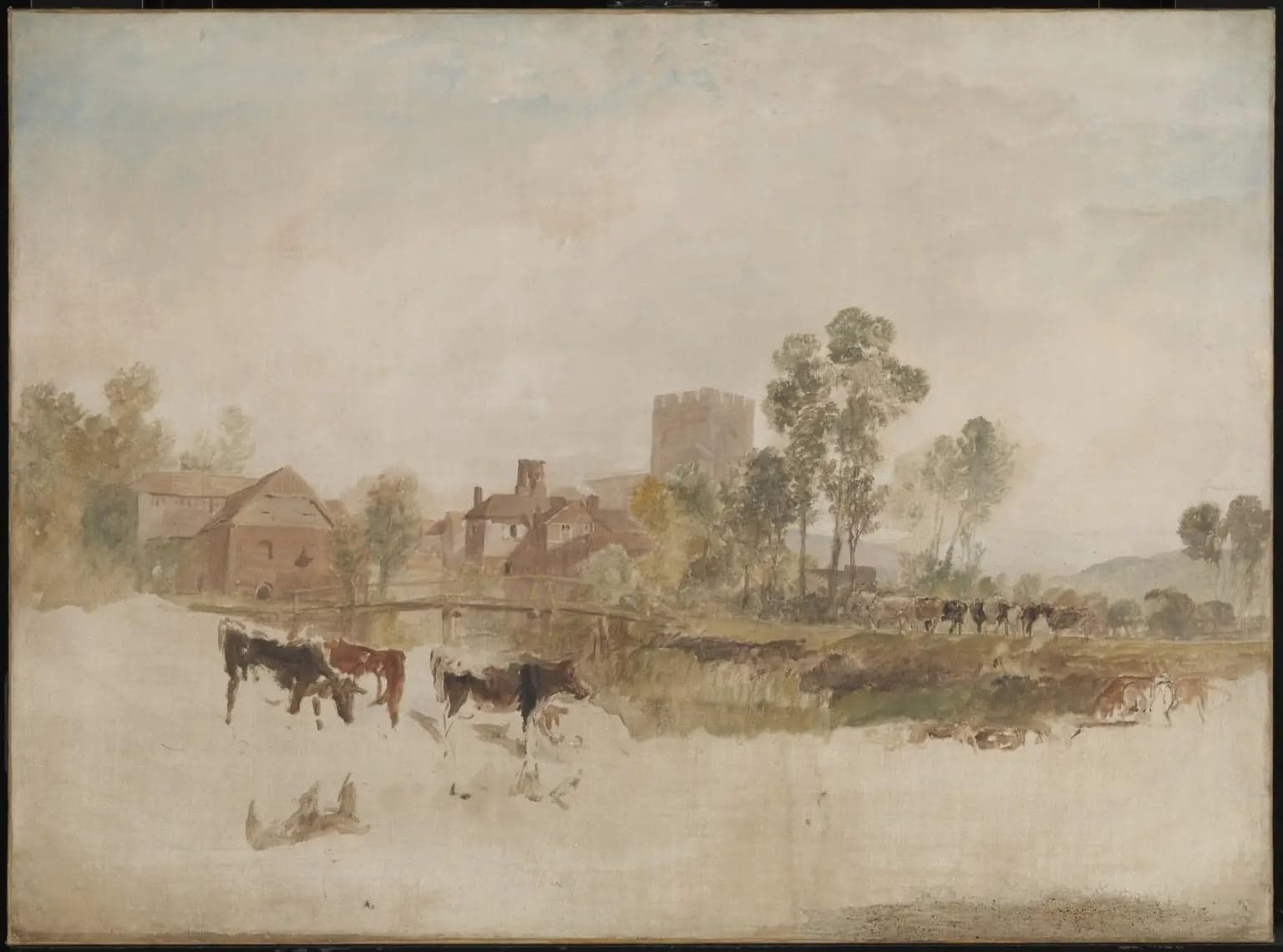
Goring Mill and Church
- Original dimensions
- 85.7 x 116.2 cm
- Museum
- Tate
- Year
- 1806
Scene depicted
The painting “Goring Mill and Church” depicts a pastoral landscape filled with light and harmony. In the background, the mill stands proudly in contrast to the village church, a symbol of a peaceful community. The play of shadow and light highlights the tranquil flow of the River Thames, inviting the viewer to contemplate this reflection of an era where the industrial and the natural coexisted in peace.
Historical context
Created in 1806, this painting is set in a rich historical context where the Industrial Revolution begins to transform the English landscape. Located in Goring-on-Thames, in the Oxfordshire region, this canvas illustrates not only Turner's technical mastery but also his commitment to nature, revealing the romantic current that runs through his work. Today, the painting resides at the Tate in London, preserved for future generations.
Place in the artist's career
This painting is situated at a turning point in Turner's career, where he explores atmospheric effects. Alongside works like “The Fighting Temeraire” and “Rain, Steam and Speed,” we see the evolution of his style, moving from a realism to a manifestly poetic one, revealing an unparalleled sensitivity to light and color.
Anecdote
“Art transcends the simple visual; it touches the soul.” These words resonate strongly in Turner's mind as he drew inspiration from the morning light in the English countryside to create this masterpiece . Imagine a spring morning, where the song of birds and the fresh breeze nourish an atmosphere of serenity, a moment captured forever in the painting .