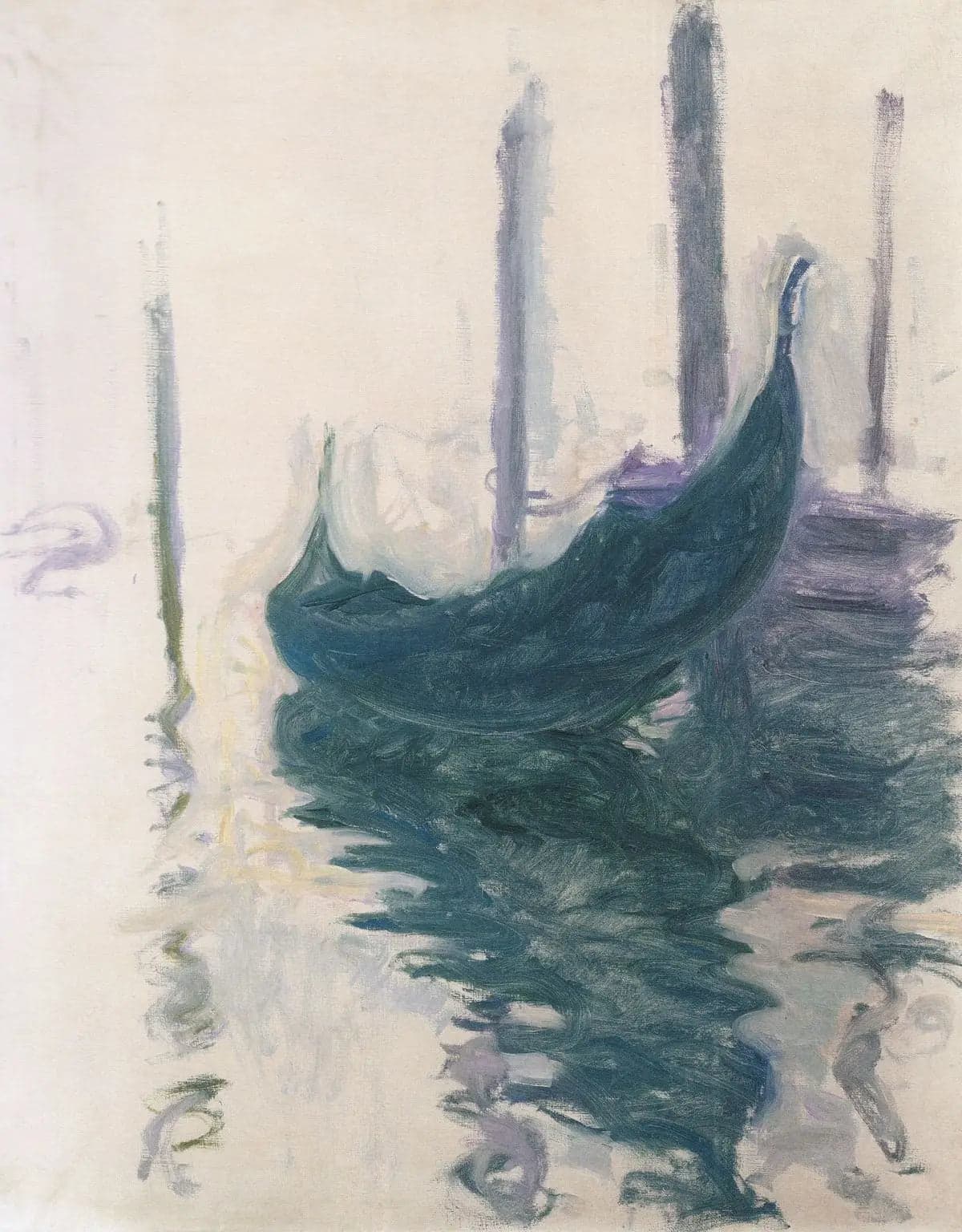
Gondolas in Venice
Scene depicted
In this fascinating pictorial work, Monet captures a fleeting moment of Venice , where the gondolas gently sway in the calm waters of the canal. Through a masterful use of light, he reveals the depth of the atmosphere, paying tribute to the ephemeral beauty of this unique city. The ripples on the water's surface are quietly interrupted by shimmering reflections, while the silhouettes of the passengers add a breath of life to this peaceful scene.
Historical context
Created in 1908 , the iconic painting Gondolas in Venice , by the illustrious Claude Monet , is part of the Impressionist movement, a revolutionary artistic current that transformed the perception of light and color. This work, currently exhibited at the Museum of Arts of Nantes , evokes the melancholic charm of the lagoon city, a true jewel of Italy. With dimensions of 65.2 x 81 cm , this canvas stands out for its softness and vibrant atmosphere.
Place in the artist's career
Gondolas in Venice is situated in a period of great maturity for Monet, marking both a stylistic peak and a deep dive into his Venetian impressions. This painting resonates with other iconic works such as Impression, Sunrise and The Water Lilies , allowing us to observe the evolution of his technique, where the interaction between color and light exerts a greater hold on the conveyed emotion.
Anecdote
Monet, the pen at the heart of this masterpiece , once confided: “Nature never leaves traces, but it evokes a memory that is always fresh, like a gondola gliding on the water.” This thought was born on a sunny morning, as the reflections of the gondolas in the Grand Canal created a hypnotic dance, inspiring a vibrant, caricatural composition of Venetian life.