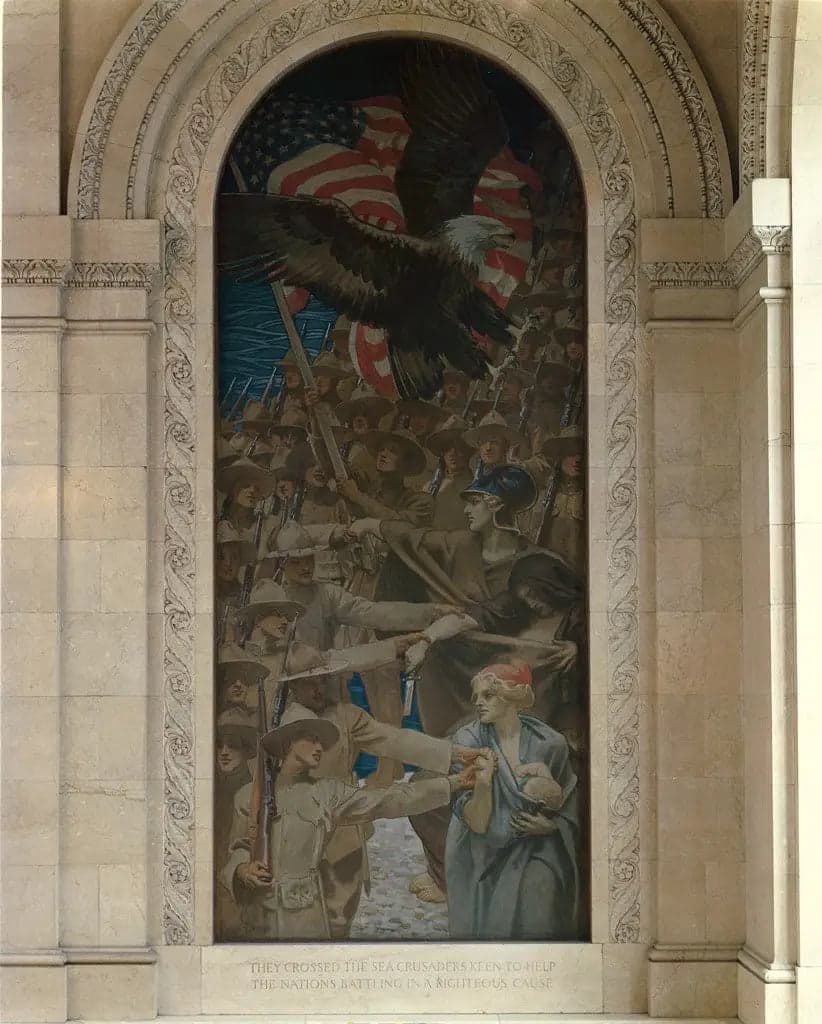
Going to War
- Original dimensions
- 186.7 x 447 cm
- Museum
- Harvard Art Museums
- Year
- 1922
Scene depicted
In this painting , Sargent depicts the delicate moment of entering into war, a tableau that powerfully captures the duality of duty and melancholy. The faces of the soldiers, imbued with determination, come alive under the play of light, telling a story of bravery and sacrifice. The painting invites reflection on the human stakes at the heart of the conflict, while celebrating the inner strength that resides within the individual when faced with adversity.
Historical context
Created in 1922, the painting titled Going to War is emblematic of the American Impressionist movement. John Singer Sargent , a virtuoso of brushwork, crafted this canvas in a post-World War I context. The painting is currently housed in the Harvard Art Museums, reflecting the American artistic legacy that celebrates both the beauty and tragedy of the human spirit. With impressive dimensions of 186.7 by 447 centimeters, this work continues to captivate visitors with its visual richness and emotional engagement.
Place in the artist's career
Going to War represents one of Sargent's stylistic peaks, marking an artistic maturity. In parallel with Carnation, Lily, Lily, Rose and The Artist's Children , one can observe an evolution in technique and emotion; while the earlier works emphasize light and color, this painting explores the depths of feelings in the face of adversity, a warm and poignant testament to Sargent's creative journey.
Anecdote
“Emotion cannot remain silent; it must reveal itself through color and light.” Sargent is said to have asserted while painting this artwork in an atmosphere marked by a collective memory of struggle. Imagine a cool morning, enveloped by the soft whisper of leaves rustling in the breeze, as the artist, attentive and sensitive, discovers the intensity of the moment through his brush. This primal emotion resonates in the evocative power of Going to War .