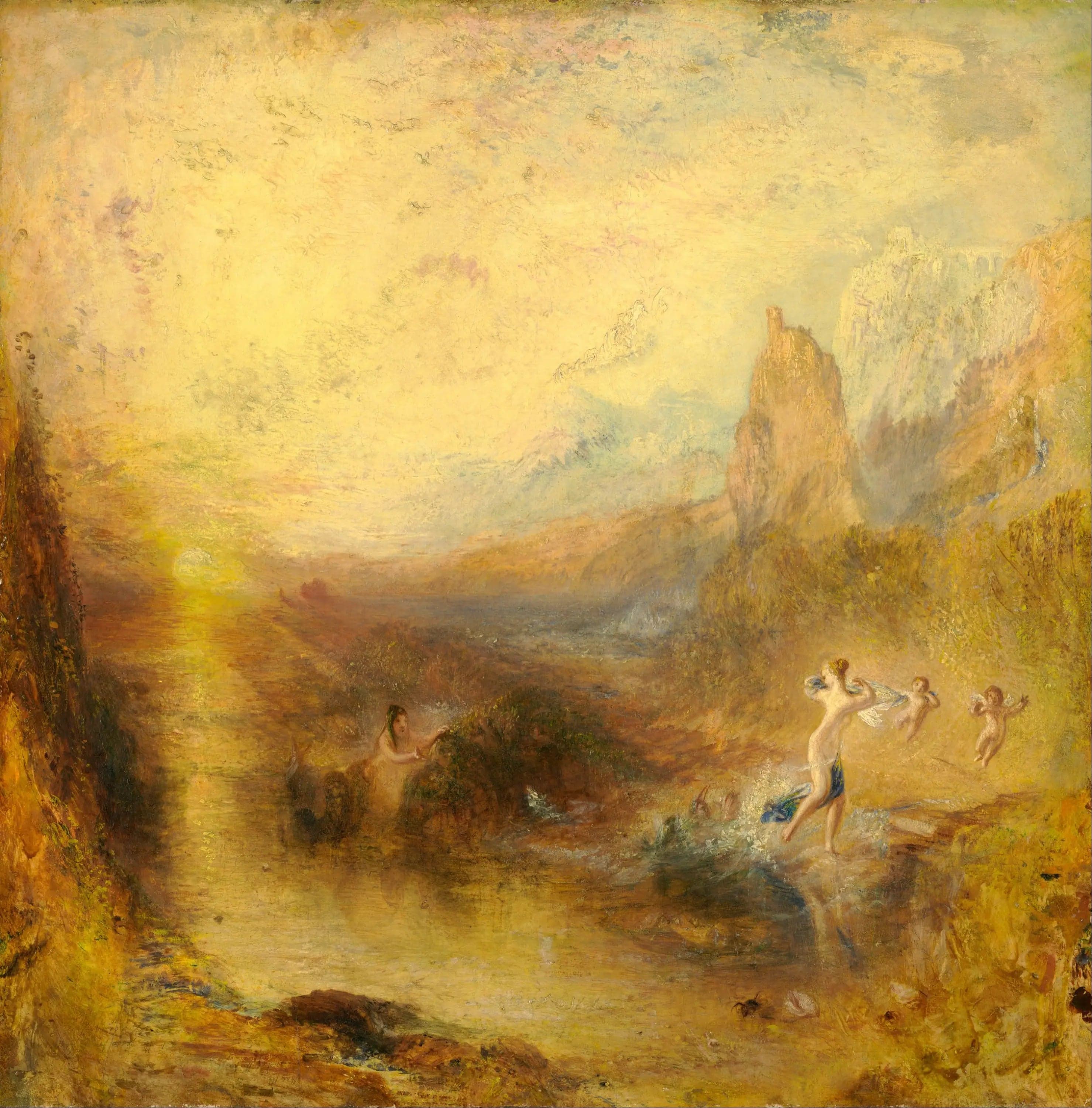
Glaucus and Scylla
- Original dimensions
- 77.5 x 78.3 cm
- Museum
- Kimbell Art Museum
- Year
- 1841
Scene depicted
The painting depicts an ancient mythological story, where Glaucus, a sea god, falls hopelessly in love with Scylla, a nymph of fallen mysteries. The scene illustrates their tragic encounter, making palpable the dramatic tension between love and rejection. The surrounding tumultuous waves and swirling clouds evoke a melancholic atmosphere, accentuating the characters' emotions.
Historical context
Created in 1841, the painting Glaucus and Scylla emanates from a time when romanticism and the expression of deep emotions took precedence over rationality. The canvas, emblematic of the romantic movement, is set in a flourishing cultural framework in London, where Turner, the undisputed master of light and movement, captivated his audience with his aquatic visions. Today, this work is housed in the Kimbell Art Museum , where it impresses with its remarkable dimensions of 77.5 x 78.3 cm.
Place in the artist's career
Glaucus and Scylla represents a turning point in Turner's career, illustrating both his technical mastery and thematic boldness. Situated in his maturity period, this painting resonates with other masterpieces, such as The Fighting Temeraire and Rain, Steam and Speed , where Turner explores nostalgia and progress, respectively, paving the way for an unprecedented visual expressionism .
Anecdote
“Nature itself is the best teacher,” Turner might have claimed, inspired by the colors and emotions of a spring morning when the idea of Glaucus and Scylla took root. In this singular moment, facing the sea, the iridescent reflections of the water and the whispers of the wind infused a decisive strength into this canvas .