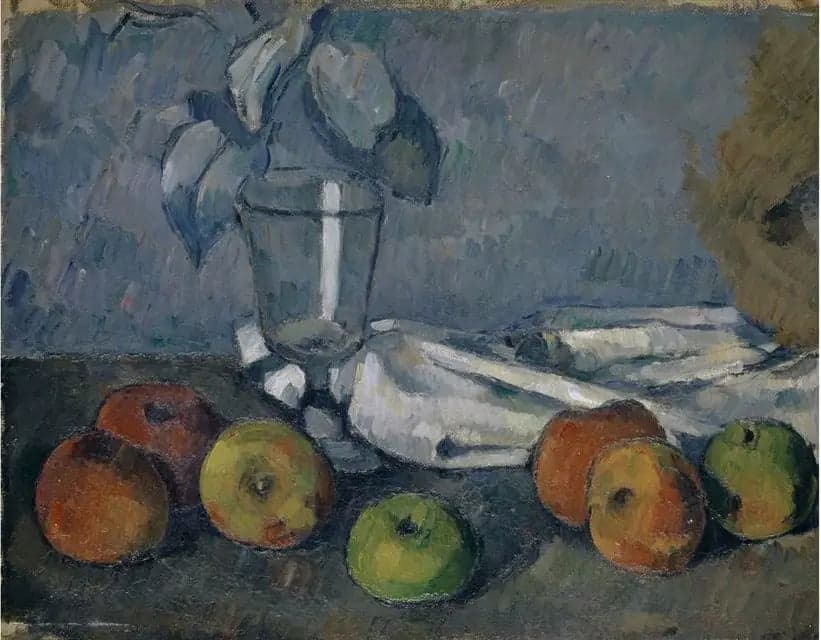
Glass and Apples
- Original dimensions
- 40 x 31.5 cm
- Museum
- Kunstmuseum Basel
- Year
- 1879
Scene depicted
In this canvas , a composition of fruits facing a glass, Cézanne invites us to appreciate the beauty of simplicity. Each element seems imbued with daylight, where colors vibrate in a silent dialogue. He transports us into an atmosphere of serenity, where every detail tells a story of delicacy and nature.
Historical context
Created in 1879, this painting is emblematic of the post-impressionism movement. Cézanne, a native of Aix-en-Provence, captured the essence of daily life in a unique style. Today, this canvas of rare elegance is preserved at the Kunstmuseum in Basel, offering a valuable insight into an era where the representation of nature and forms reigned supreme.
Place in the artist's career
Glass and Apples fits into Cézanne's period of maturity, marking a turning point in his pictorial approach. Alongside The Large Bathers and The Montagne Sainte-Victoire, this canvas illustrates his technical evolution towards a simplification of forms while enriching the depth of color.
Anecdote
“Nature reveals itself only in light,” said Cézanne, inspired by the soft morning rays on his juicy apples and glass. At that time, in his light-filled studio, he painted passionately, seeking to capture those fleeting moments that resonate with our daily lives, and thus this masterpiece was born.