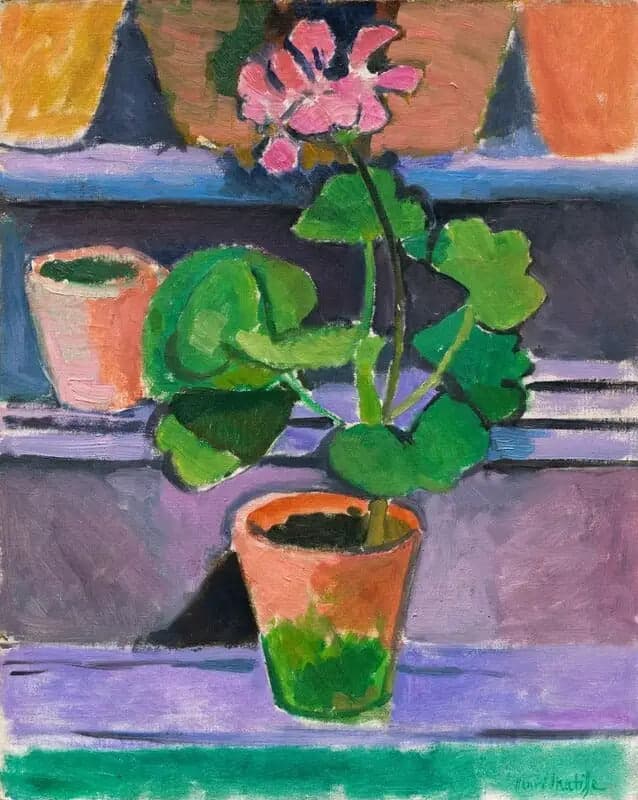
Geranium Pot
- Original dimensions
- 33.3 x 41.3 cm
- Museum
- National Gallery of Art
- Year
- 1912
Scene depicted
In this pictorial work , Matisse invites us to dive into the intimacy of a space where nature meets the everyday. The pot of geraniums, ostentatious and energetic, radiates life while the saturated colors dance on the canvas. It is a painting that testifies to the simplicity and beauty of small things, capturing a moment of serenity in the tumult of urban life.
Historical context
Created in 1912, this painting was born in Paris, the true artistic epicenter of the time. Matisse, an emblematic figure of fauvism , wanted to capture the vibrant light of this bustling city. Currently, the canvas is preserved at the National Gallery of Art , where it continues to move its visitors with its simplicity and beauty. Its dimensions, 33.3 x 41.3 cm, make it a work that is both intimate and accessible.
Place in the artist's career
Pot de géraniums is part of a period where Matisse boldly explores the possibilities of color and composition. This canvas can be compared with other works such as “The Dance” and “The Joy of Life,” where the artist notes the transition from exploring motifs to a quest for pure sensations, affirming his stylistic maturity.
Anecdote
Henri Matisse once stated: “Color has a power of expression to which I cannot resist.” It was on a bright morning in Nice, when the blooming geraniums illuminated his garden, that the idea for this stunning canvas came to him. The strength of this painting lies in the harmony of colors, evoking joy and serenity of a privileged moment.