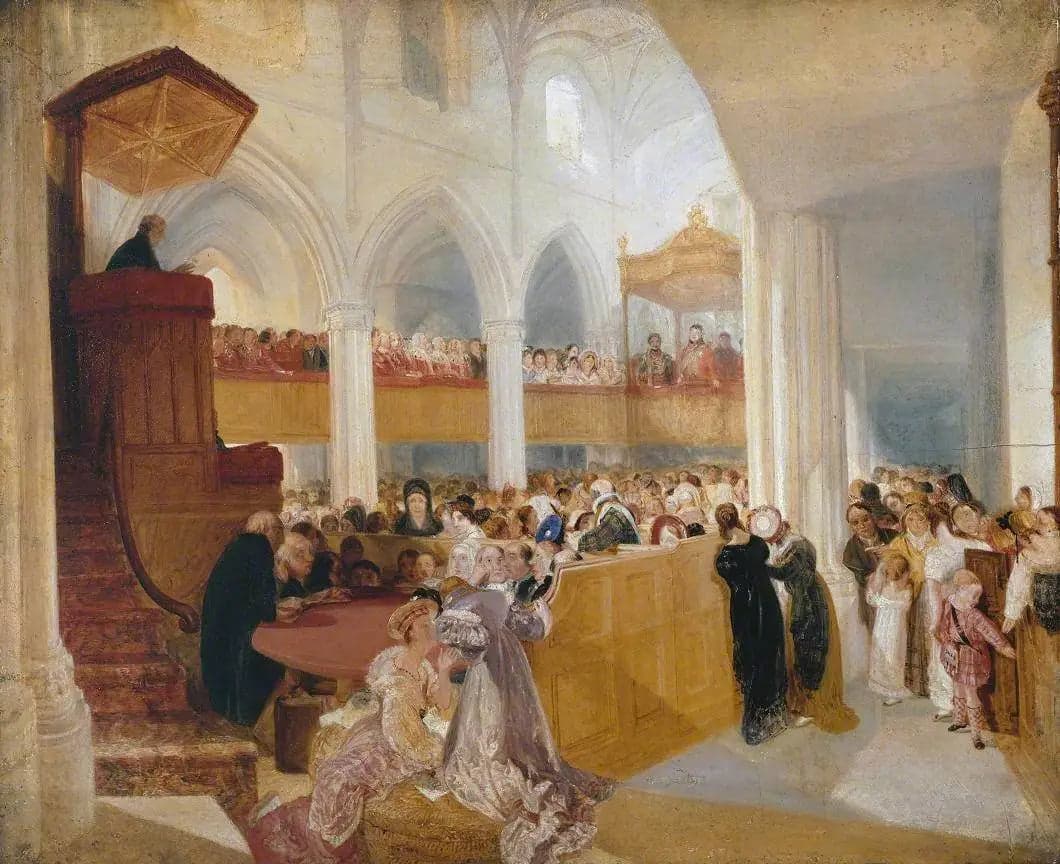
George IV at St Giles's, Edinburgh
- Original dimensions
- 74.6 x 91.8 cm
- Museum
- Tate
- Year
- 1822
Scene depicted
This iconic painting depicts King George IV during his triumphant visit to Edinburgh in 1822. The pictorial work unfolds in a festive context, within the majestic St Giles's church, where the artist succeeded in capturing the excitement of the crowd and the palpable emotion of the event. The composition invites the viewer to feel the fervor of the royal welcome and the excitement of a nation in search of identity.
Historical context
Created in the heart of the 19th century, this painting is emblematic of the romantic movement, where the English artist Joseph Mallord William Turner captured the vibrant essence of his time. Evoking royal splendor in Scotland, the painting is now housed at the Tate , where it continues to enchant entire generations of admirers. With its generous dimensions of 74.6 x 91.8 cm, this canvas tells a story that is both personal and collective, resonating with the historical echoes of the Scottish capital.
Place in the artist's career
This canvas represents a turning point in Turner’s career, establishing a balance between the desire for modernity and respect for pictorial traditions. Alongside his masterpieces such as "The Fighting Temeraire" and "Rain, Steam and Speed," we observe here a stylistic maturity that testifies to his growing influence on the upcoming impressionist movement.
Anecdote
“Every brushstroke must be guided by the soul of the subject,” Turner might have said while contemplating the historic buildings of Edinburgh. Imagine him, one spring morning, strolling through the cobbled streets, inspired by the faces of passersby, ready to immortalize the majesty of King George IV in this monumental work. This act of creation transcends time, connecting the artist to the cushions of the past through his painting .