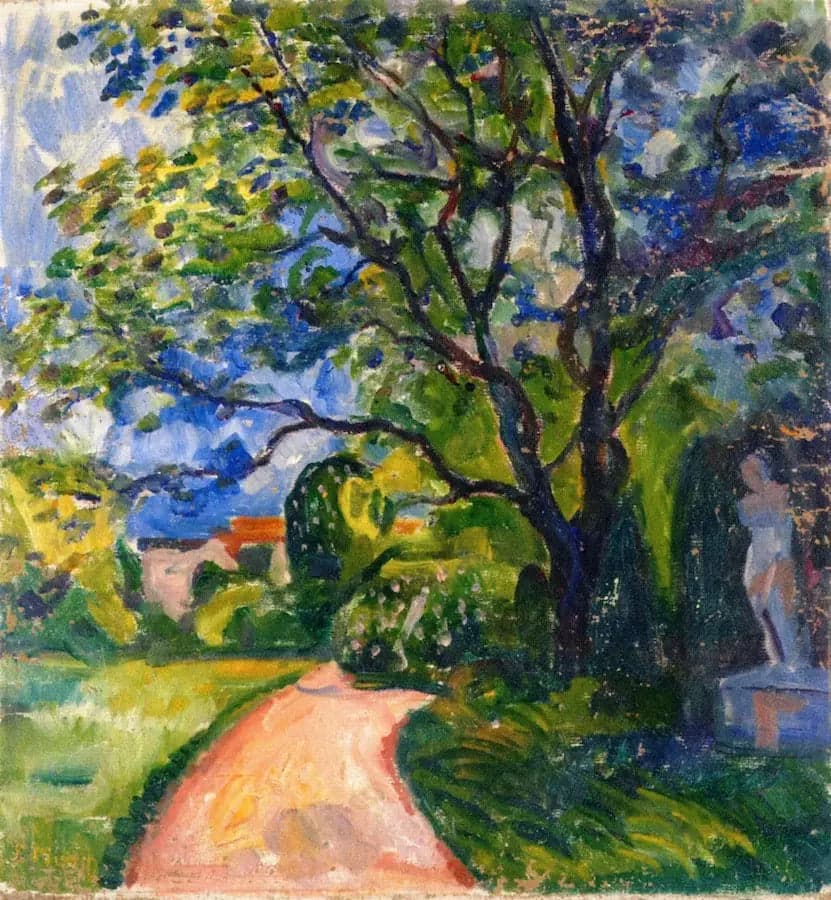
garden in Lübeck
- Original dimensions
- 66.8 x 72.3 cm
- Museum
- Munch Museum
- Year
- 1903
Scene depicted
At the heart of “garden in Lübeck,” the artist invites us to wander through an idyllic landscape, where nature awakens tenderly. The vibrant flowers and soft shadows create a tranquil and melancholic atmosphere, reminding us of the fragility of these moments of beauty. Munch, with his characteristic style, manages to capture the very essence of life, where each element of the garden reflects a delicate harmony.
Historical context
Created in 1903 in the charming city of Lübeck, this painting is emblematic of the expressionist movement, characteristic of the time of its creator, Edvard Munch . The painting, currently housed in the Munch Museum in Oslo, perfectly symbolizes the artist's quest to express human emotions through his pictorial works. With dimensions of 66.8 x 72.3 cm, every detail of this canvas aspires to capture the ephemeral beauty of nature.
Place in the artist's career
“garden in Lübeck” represents a crucial step in Munch's career, illustrating his artistic evolution. This masterpiece emanates from a period when the artist explores the relationship between man and nature, akin to his other famous works such as “The Scream” and “The Madonna.” In each of these canvases , a common quest is perceived: that of inner truth and the expression of emotions.
Anecdote
“In the garden, the light dances on the leaves and announces spring.” These words from Edvard Munch recall the moment when the artist was inspired by the simple and serene beauty of a Lübeck garden, one spring morning. This memory is palpable in the painting , transforming each brushstroke into an echo of emotion and delicacy.