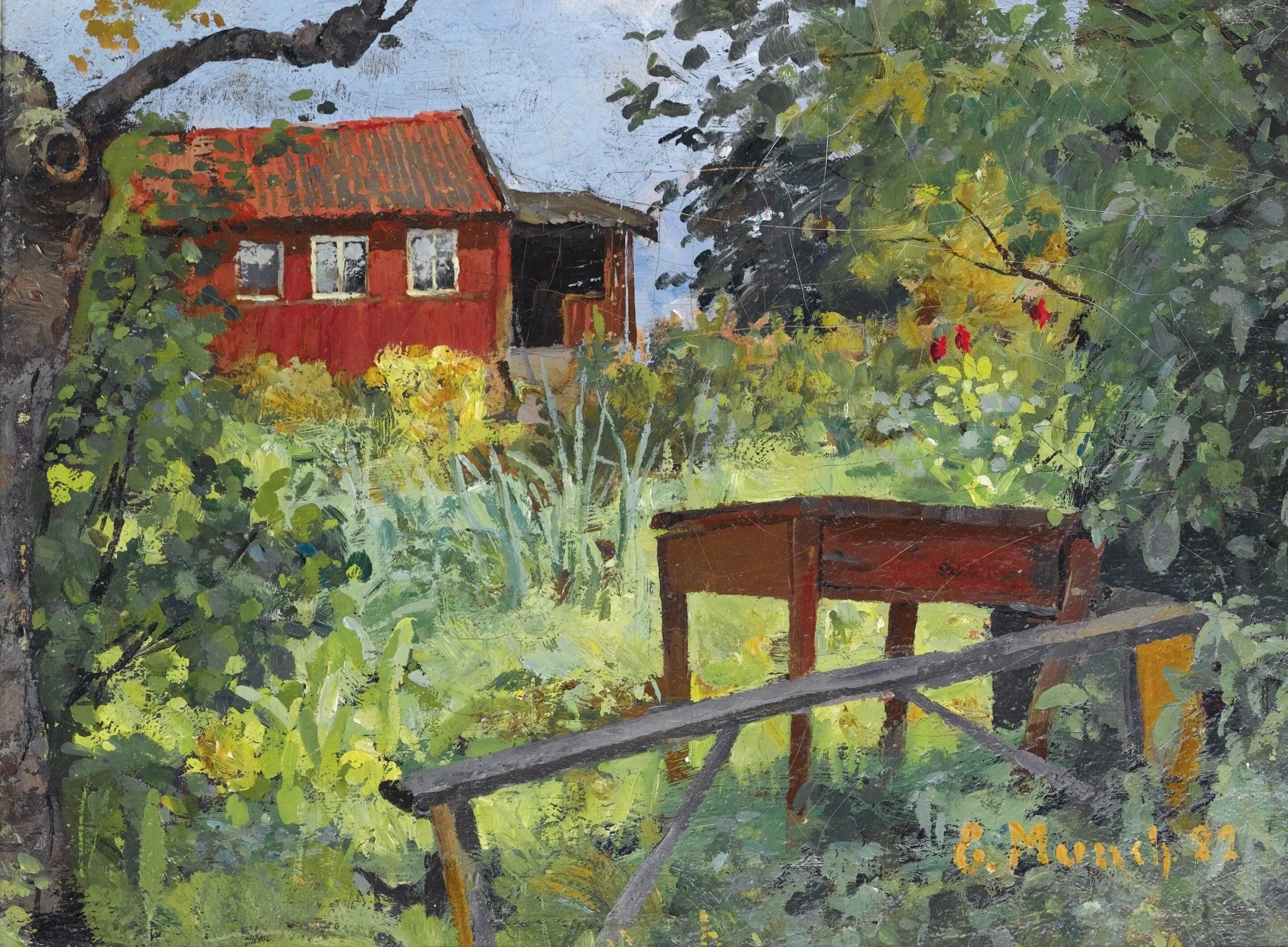
garden at the red house
- Original dimensions
- 30.5 x 23 cm
- Museum
- Not specified
- Year
- 1882
Scene depicted
The painting “garden at the red house - Edvard Munch ” immerses us in an intimate and serene landscape. This green space, inhabited by light and shadow, invites the viewer to silent contemplation. With its vibrant colors and soft shapes, the composition evokes an ideal refuge, a garden where each plant seems to tell a story, brushing against the melancholy and beauty of everyday life.
Historical context
Created in 1882, during a period of cultural upheaval in Oslo, this painting marks the transition between realism and impressionism , characteristic of Munch's early artistic years. Evoking themes such as human nature and solitude, this canvas bears witness to the creative momentum of a time when art begins to question emotions. This painting , although not exhibited in a well-known museum, aims to be a vibrant representation of a garden, both indoors and outdoors.
Place in the artist's career
Francisca Munch is not simply at the beginning of her career with garden at the red house , but this canvas also marks a nascent maturity in her technique. Alongside The Scream and The Madonna , this work reveals the rise of an artist in search of emotional depth, offering a striking contrast between movement and tranquility.
Anecdote
“Nature is my muse, but it is in the garden of my house that I was able to scrutinize its secrets.” This reflection from Edvard Munch evokes a particular moment when, one spring morning, he discovered a new light playing on the leaves, revealing sensations long buried. It is this emotion that nourished the creation of his masterpiece , garden at the red house , which has become an iconic work.