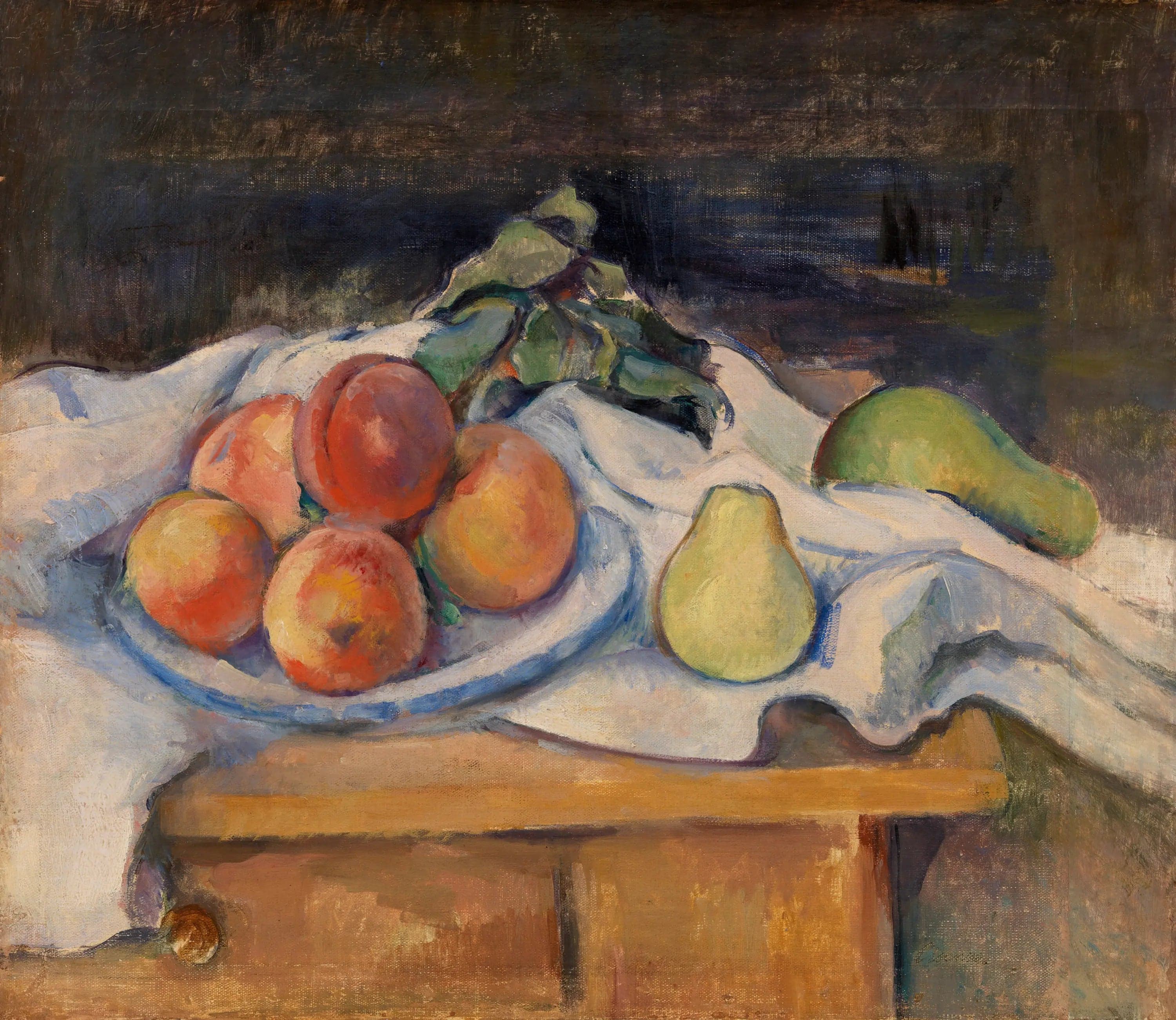
Fruits on the Table
- Original dimensions
- 44.5 x 38.5 cm
- Museum
- Barnes Foundation
- Year
- 1891
Scene depicted
The scene illustrated in this pictorial work brings together a harmony of everyday objects: juicy oranges, crunchy apples, and ripe pears, all carefully arranged on a table. The colors intertwine in a visual dance, testifying to Cézanne's genius in transforming the banality of life into art. This painting thus becomes a celebration of the everyday, sublimating the simple through the artist's eye.
Historical context
Created in 1891, this canvas emblematic is the result of the deep reflection of Paul Cézanne , an innovative artist of Post- Impressionism . Painted in a studio in Aix-en-Provence, in the sunny region of Provence, this painting communicates with the soft and warm light of southern France. The painting is currently preserved at the Barnes Foundation , a sanctuary of artworks located in Philadelphia, where visitors can admire its beauty in a clean setting.
Place in the artist's career
Fruits sur la table marks a turning point in Cézanne's career, an advance towards a stylistic maturity that resonates with his other masterpieces , such as “La Montagne Sainte-Victoire” and “Les Grandes Baigneuses.” In each of these paintings , one observes a growing mastery of form and color, revealing a dialogue between objects and their environment.
Anecdote
“Nature is my only mistress,” said Cézanne, inspired by the simple yet powerful spectacle of fruits arranged on a table. That morning, his brushes capture a golden light filtering through the window, awakening the vibrant hues of a composition of fruits that speak to the soul, a moment suspended between appearance and essence in his famous painting .