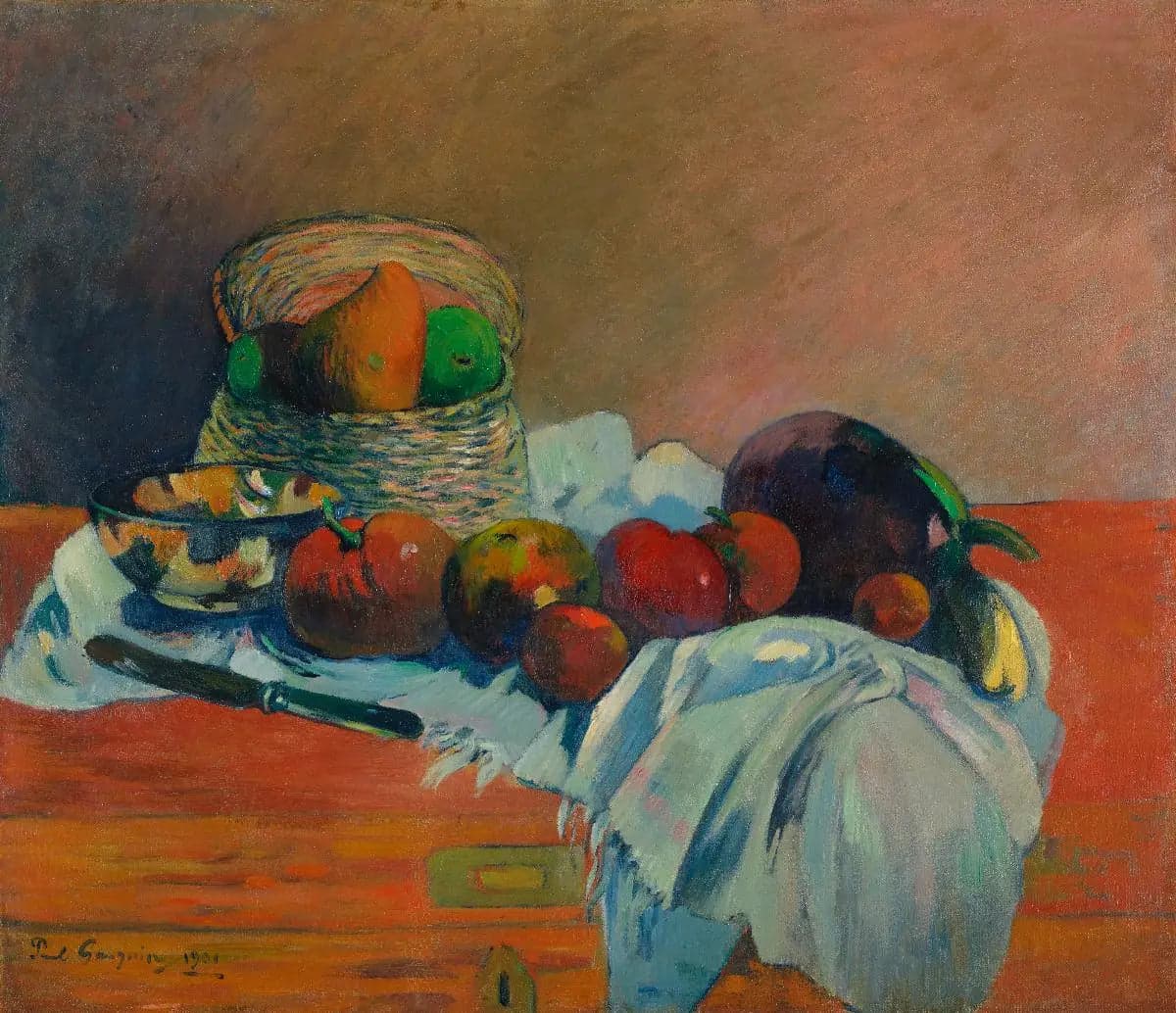
Fruits and Knife
- Original dimensions
- 75 x 66 cm
- Museum
- Foundation and Collection Emil G. Bührle
- Year
- 1901
Scene depicted
In this painting , the composition draws the eye with its harmony between natural elements and the discreet presence of a knife. The juxtaposition of these objects evokes both the simplicity of everyday life and the complexity of inner life. Gauguin succeeds in transcribing the essence of the fruits with a keen sense of volume and light, making this canvas an ode to the ephemeral beauty of nature.
Historical context
Created in 1901 in Pont-Aven, a coastal town in Brittany, this painting is at the heart of the post impressionist movement. Under the influence of Synthetism, Gauguin communicates an intimate and colorful vision of nature, where every detail resonates with deep emotion. Today, this canvas is carefully preserved at the Foundation and Collection Emil G. Bührle , thus enriching the artistic experience of visitors.
Place in the artist's career
Fruits et knife is situated at a significant turning point in Gauguin's career. After exploring impressionism , he embraces a bolder new style. In parallel with works like Vision after the sermon and The Yellow Christ , this painting manifests a journey towards a more personal and stylized expression.
Anecdote
“Nature is a mirror to the soul,” declared Gauguin, echoing his inspiration during the creation of this pictorial work . Imagine him, one spring morning, wandering through the fruit markets of Brittany, absorbing the golden sunlight that illuminates the vibrant colors. Each fruit on his canvas becomes a symbol, a capture of a fleeting moment full of life.