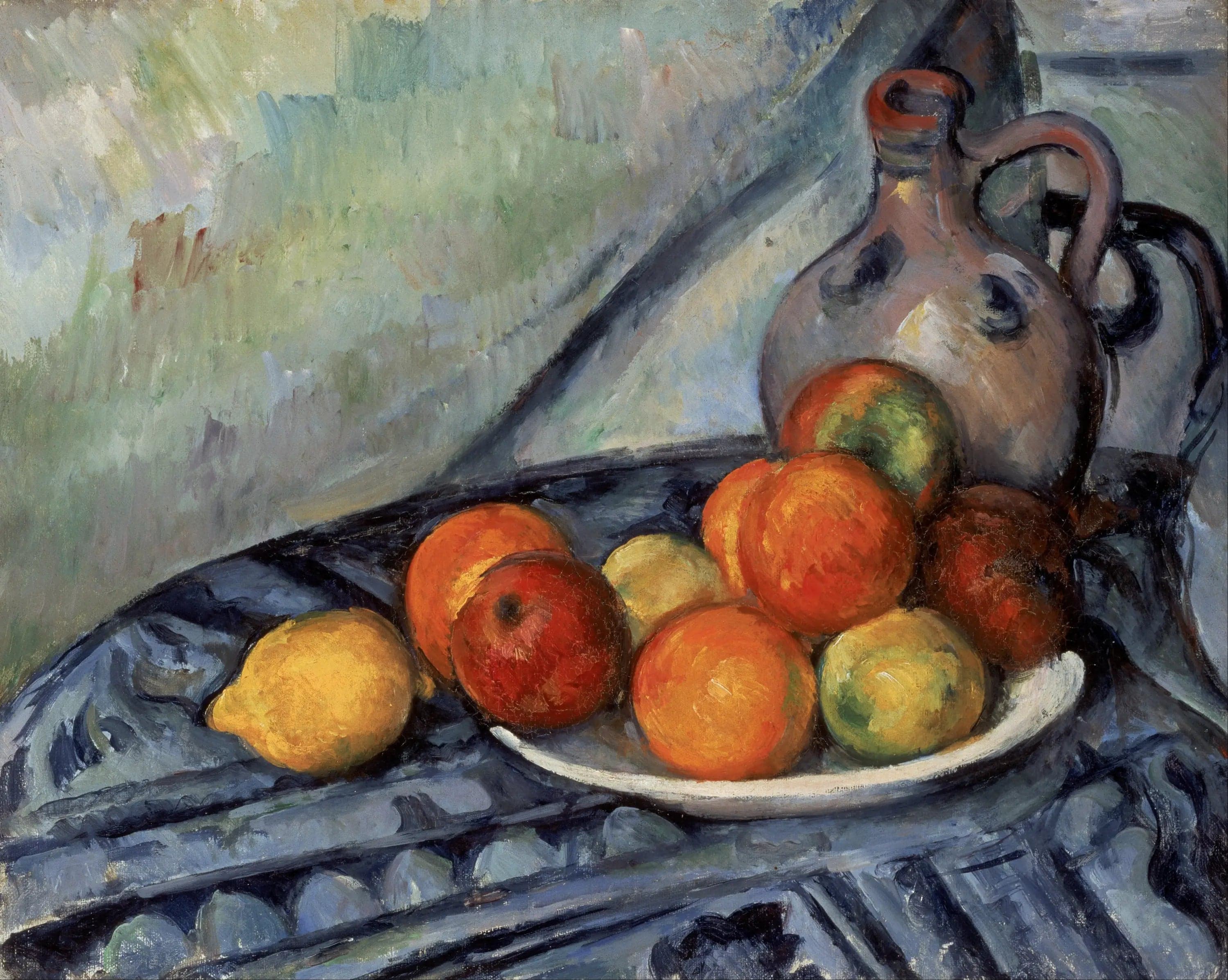
Fruits and Jug
- Original dimensions
- 40.6 x 32.4 cm
- Museum
- Museum of Fine Arts Boston
- Year
- 1890
Scene depicted
The painting "Fruits et cruchon" by Paul Cézanne is an ode to nature and the richness of colors. It reveals a harmonious composition of carefully arranged fruits, contrasted by the freshness of a terracotta jug. Each element, luminous, breathes vitality and character. Indeed, this canvas invites a meditative contemplation, where the viewer can almost feel the fruity textures and the sweet scent of peaches and pears.
Historical context
Created in 1890 in Aix-en-Provence, the painting "Fruits et cruchon" is part of the post-impressionist movement. At that time, Cézanne was establishing himself as one of the pioneers of modern art, transforming the canvas through a colorful prism and simplified forms. Today, this painting proudly resides at the Museum of Fine Arts Boston , testifying to its importance in the evolution of painting.
Place in the artist's career
"Fruits et cruchon" represents a period of maturity in Cézanne's career, a moment when he manages to merge his love of nature with an advanced mastery of volume and color. Echoing other paintings like "La Montagne Sainte-Victoire" and "Still Life: Apples and Skull", this work is part of a constant exploration of movement and light.
Anecdote
“I want to show nature as I feel it, with an intensity that only my brushes can capture.” These are words that resonate strongly when contemplating the masterpiece "Fruits et cruchon". Inspired by the soft light of a spring morning, the artist managed to capture in this work all the simple yet vibrant beauty of everyday life.