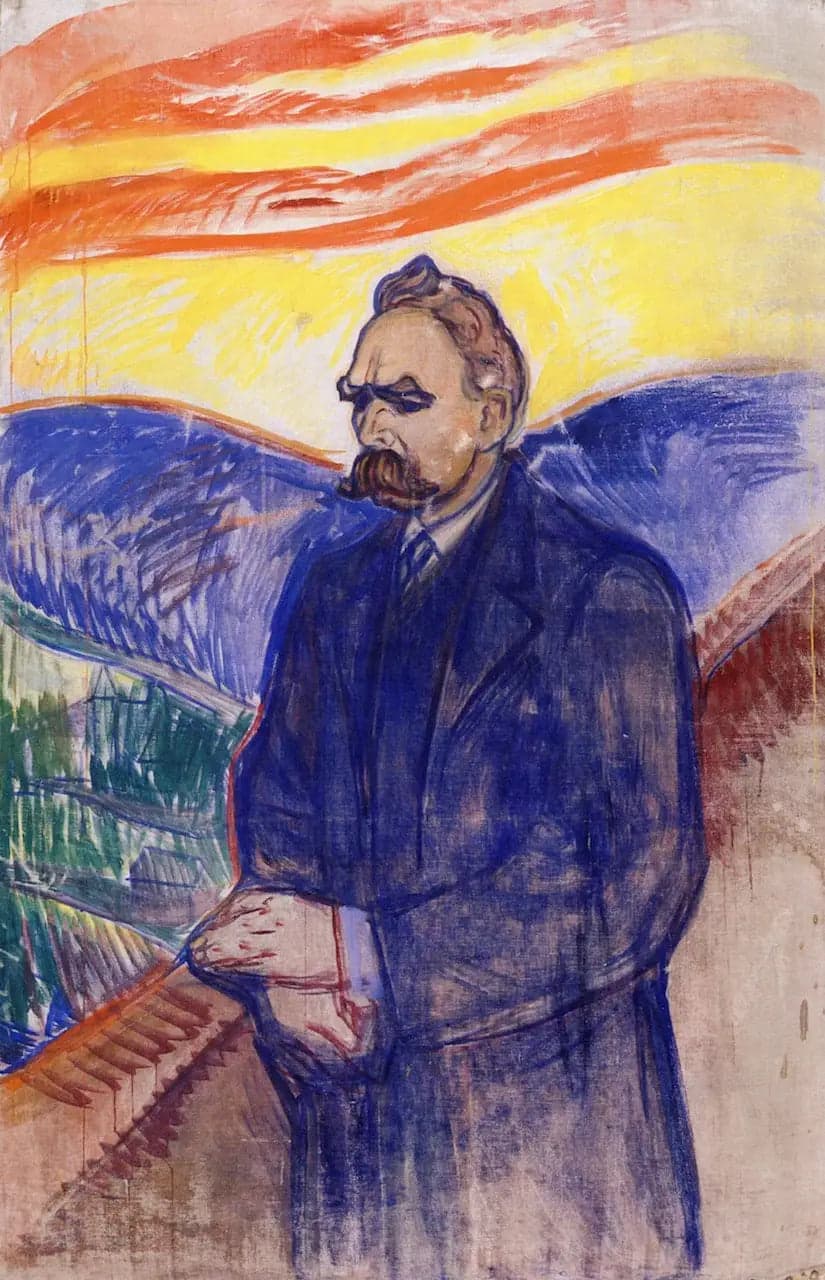
Friedrich Nietzsche
- Original dimensions
- 130 x 201 cm
- Museum
- Munch Museum
- Year
- 1906
Scene depicted
In this canvas , Munch depicts the philosopher Frédéric Nietzsche in a reflective posture, with a gaze that is both piercing and melancholic. The composition highlights the conflict between light and shadow, symbolizing the inner struggles of the martyr of modern thought. Nietzsche, at the heart of the scene, evokes existential angst, his face illuminated by vibrant hues that speak directly to the soul.
Historical context
Created in 1906, this painting is emblematic and takes place in the heart of Oslo, a vibrant city in Norway. In a context of artistic renaissance, Edvard Munch explores the psychological depths of human existence, marking the emergence of the expressionist movement. The canvas is currently exhibited at the Munch Museum, where it attracts the attention of art enthusiasts from around the world, offering a fascinating insight into the dimensions of 130 x 201 cm.
Place in the artist's career
This canvas represents a crucial turning point in Munch's career. It falls within a period of deep introspection and stylistic maturation. It juxtaposes with works like *The Scream* and *The Madonna*, thus representing a rich evolution both technically and emotionally, marking the transition from a naturalistic technique to a more subjective and expressive exploration.
Anecdote
“Every face tells a story, but some are more radiant than others,” Munch is said to have remarked. Imagine him, that morning, in a narrow alley bathed in golden light, where he crosses an intense gaze. This fleeting moment inspires him to bring this masterpiece to life. The evocative power of this painting captures the essence of human emotions, transcendent and timeless.
Major exhibitions
Edvard Munch : portraits