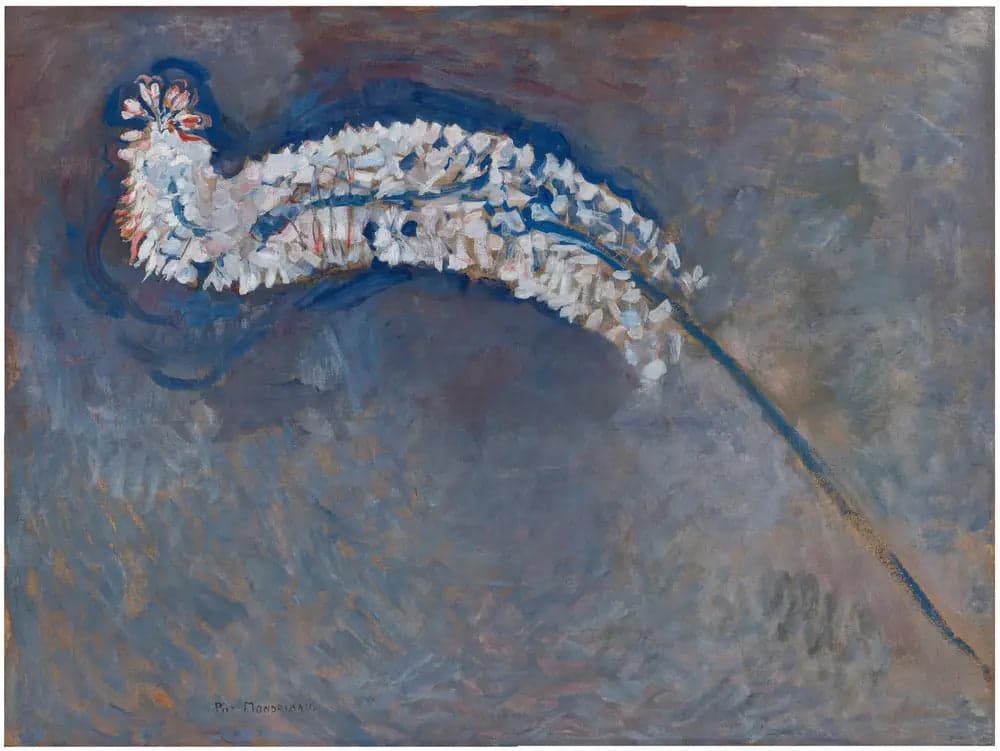
Fox Tail
- Original dimensions
- 100.5 x 75 cm
- Museum
- Not specified
- Year
- 1909
Scene depicted
The painting "Foxglove" stands before us as an ode to nature. The long petals of the foxgloves, an extravagant marriage of shapes and colors, seem to dance in a light breeze. Mondrian does not merely represent a still life; he transports us into a vibrant dialogue between light and shadow, capturing the evanescence of each moment.
Historical context
Year: 1909 |BRK| Museum: Not specified |BRK| Dimensions: 100.5 x 75 cm
Place in the artist's career
Positioned at a turning point in Mondrian's career, "Foxglove" represents a crucial milestone, where he begins to distill his abstract ideas for the benefit of sensory perception. In parallel, we can associate it with his earlier work such as "Composition in Red, Blue and Yellow" and his famous "Painting in Red, Blue, and White", reflecting his stylistic and emotional evolution.
Anecdote
"Every color is a note, every shape a melody," Mondrian once declared, explaining the symphony he felt while observing nature. It was on a spring morning, as the flowers began to bloom, that a rare light inspired him to create this masterpiece . This perfectly illustrates the evocative power of the painting "Foxglove".