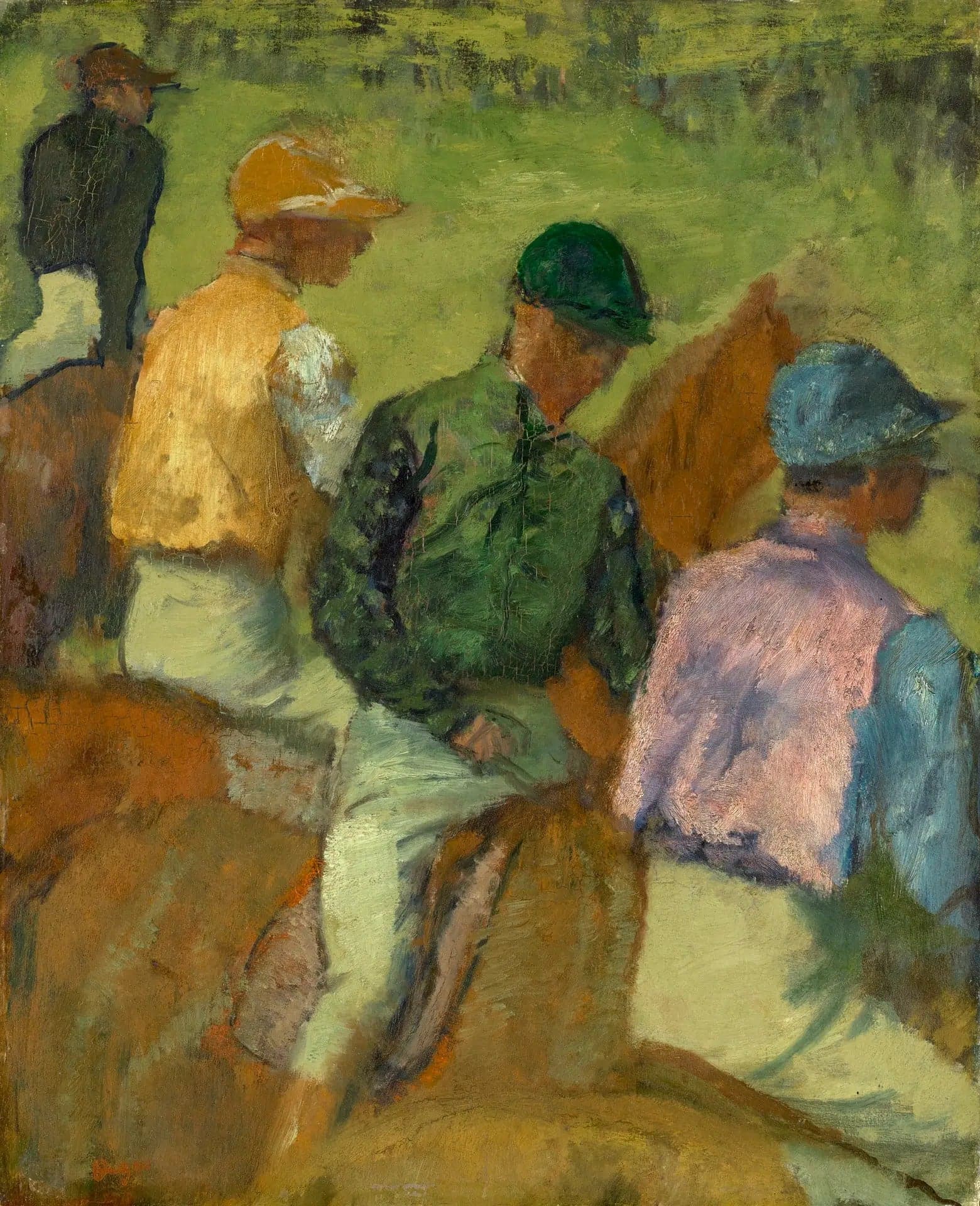
Four Jockeys
- Original dimensions
- 37.15 x 46.04 cm
- Museum
- Yale University Art Gallery
- Year
- 1889
Scene depicted
The painting "Four Jockeys" depicts a snapshot of the race with dynamic precision. We see the jockeys, frozen in their forward movements, their mounts imposing themselves in the scenery. Degas skillfully plays with angles, creating a sense of depth and urgency that transports the observer to the heart of the action.
Historical context
Created in 1889, this painting , emblematic of the Impressionist movement, immerses us in the heart of horse racing in Paris. Degas, celebrated for his interest in modern life and his use of light, sought to capture this dynamic scene, enveloped in a vibrant atmosphere, where movement reigns supreme. Today, this canvas is part of the prestigious collection of the Yale University Art Gallery .
Place in the artist's career
“Four Jockeys” represents a pivotal phase in Degas's career, showcasing his mature style. In parallel with paintings such as “The Dance Class” and “Before the Show,” one perceives a fascinating technical evolution, where gesture and movement become predominant elements of his painting .
Anecdote
Degas said: “Color is the very form of the spirit.” One spring morning, he stood backstage at a racetrack, observing the jockeys prepare. This mix of agitation and anticipation inspired this pictorial work , where every detail vibrates with the effort of the horses and men.