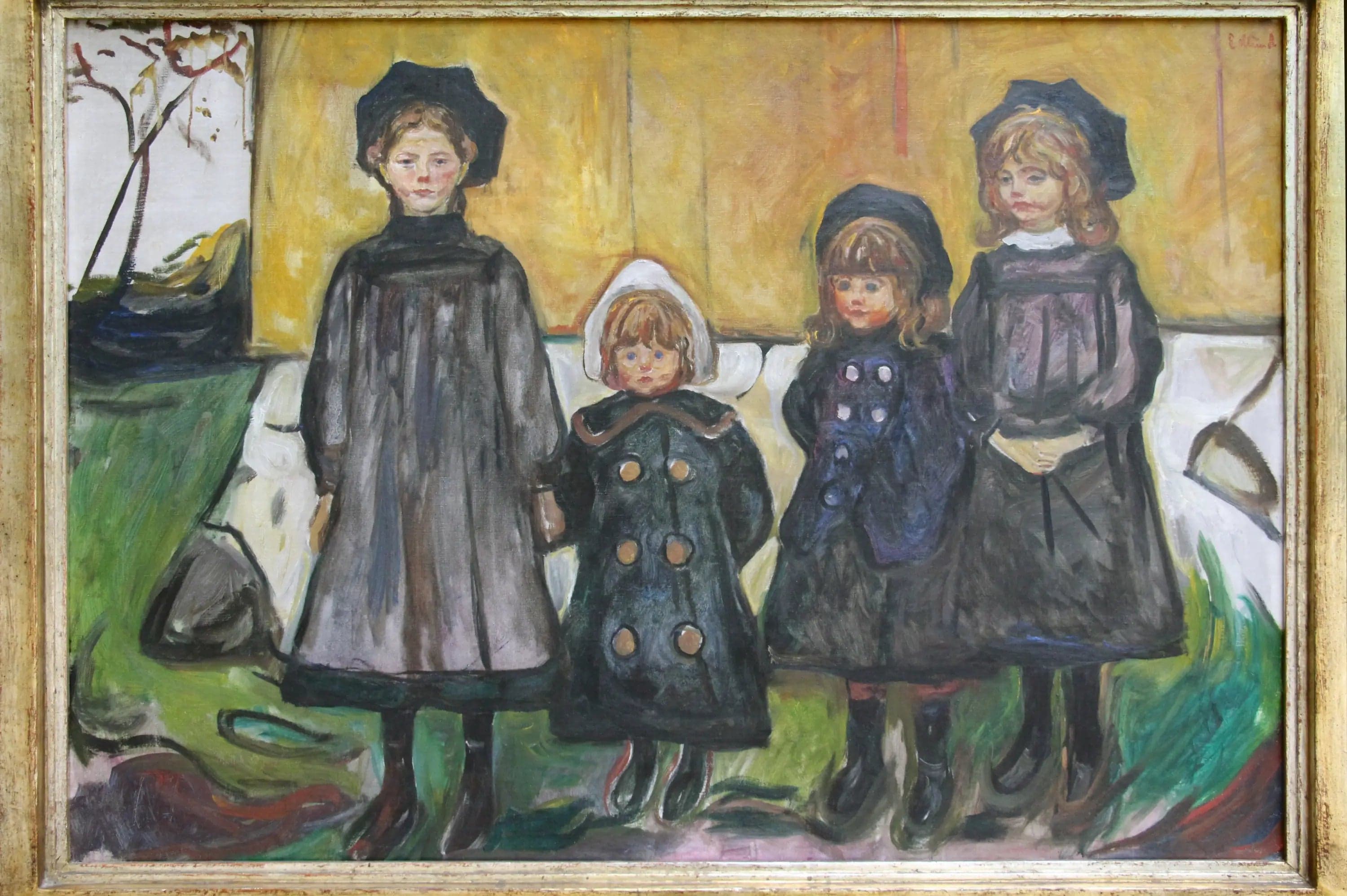
Four Girls at Åsgårdstrand
- Original dimensions
- 111 x 87 cm
- Museum
- Munch Museum
- Year
- 1903
Scene depicted
Quatre Filles à Åsgårdstrand is a canvas that evokes the ephemeral beauty of adolescence. Munch presents us with a group of young women, captured in a moment of reflection and subtle connection with their environment. The evocation of a summer truce and a bond with nature shines through their poses, creating a composition that is both tangible and mysterious.
Historical context
Created in 1903, this painting emblematic of Edvard Munch captures the essence of a deeply introspective artistic period. It fascinates with its representation of human emotions, closely linked to the expressionist movement, which was emerging in Norway, in the charming village of Åsgårdstrand. The painting is now housed in the Munch Museum in Oslo, a sanctuary for admirers of the artist.
Place in the artist's career
This painting is at the heart of Munch's stylistic transition, a promising beginning that heralds future masterpieces such as The Dance of Life and The Scream. During this period, the painter explores the depths of the human soul, thus transcending the limits of mere representation.
Anecdote
Edvard Munch once stated: "I want to paint the soul of people, their fears and their joys." It was on a misty morning in this picturesque coastal village that he found inspiration for this masterpiece , surrounded by the gentle murmur of the waves and the salty scent of the sea air. This atmosphere imbued with calm undoubtedly shaped the emotional intensity of the resulting painting .