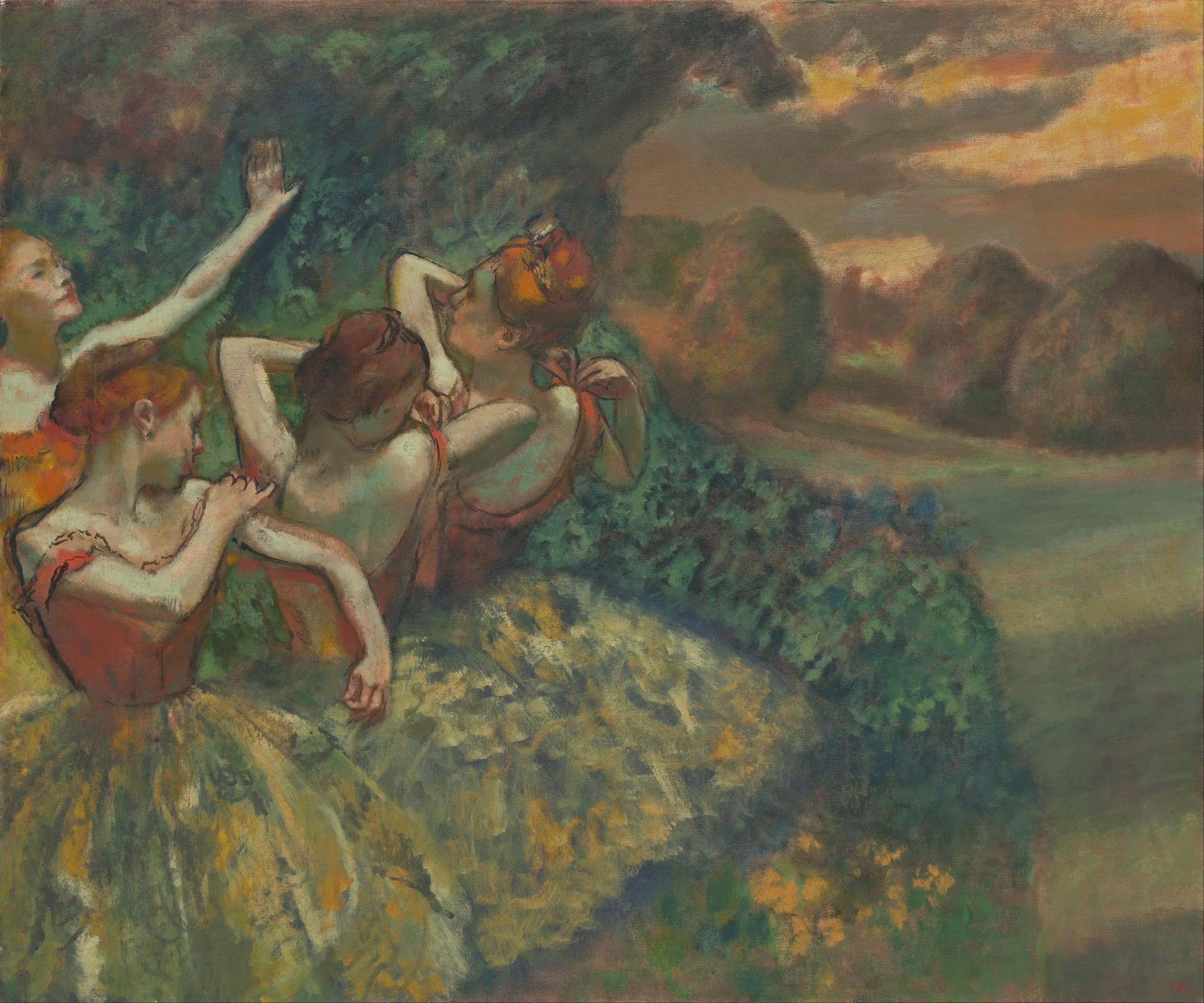
Four Dancers
- Original dimensions
- 180.2 x 151.1 cm
- Museum
- National Gallery of Art
- Year
- 1899
Scene depicted
“Four Dancers” presents itself as a true visual ballet. The scene depicts a rehearsal, where four dancers, in elegant posture, prepare to embrace the stage. Degas, with unparalleled mastery, plays with angles and perspective, creating a dynamic that vibrates the viewer's gaze. Each movement is an ode to the beauty and discipline of the dancers, revealing both the rigor of a meticulous art and the passion that flows from it.
Historical context
Created at the end of the 19th century, this painting is iconic and resonates at the heart of impressionism , capturing the artistic effervescence of Paris. The canvas, currently housed at the National Gallery of Art , unfolds in all its grandeur, testifying to an era marked by unprecedented creative flourishing. Degas, a subtle observer of urban life and, in particular, the world of ballet, infused this composition with a captivating atmosphere.
Place in the artist's career
This pictorial work represents a turning point in Degas's career. Considered a sum of his research and stylistic experiments, it fits into a period of maturity. Like “The Dance Class” and “Dancer Adjusting Her Slipper,” “Four Dancers” offers a deep look at the art of ballet, showing the technical evolution of the painter who breaks free from conventions to explore the dynamics of movement.
Anecdote
Edgar Degas said: “Art is the most beautiful of lies.” It was in the tumult of a dance studio, one spring morning, filled with the crystalline bursts of laughter and whispers of the dancers, that he drew the very essence of this masterpiece . This fleeting moment, this golden light filtering through the windows, inspired him to immortalize the grace and energy of the canvas .