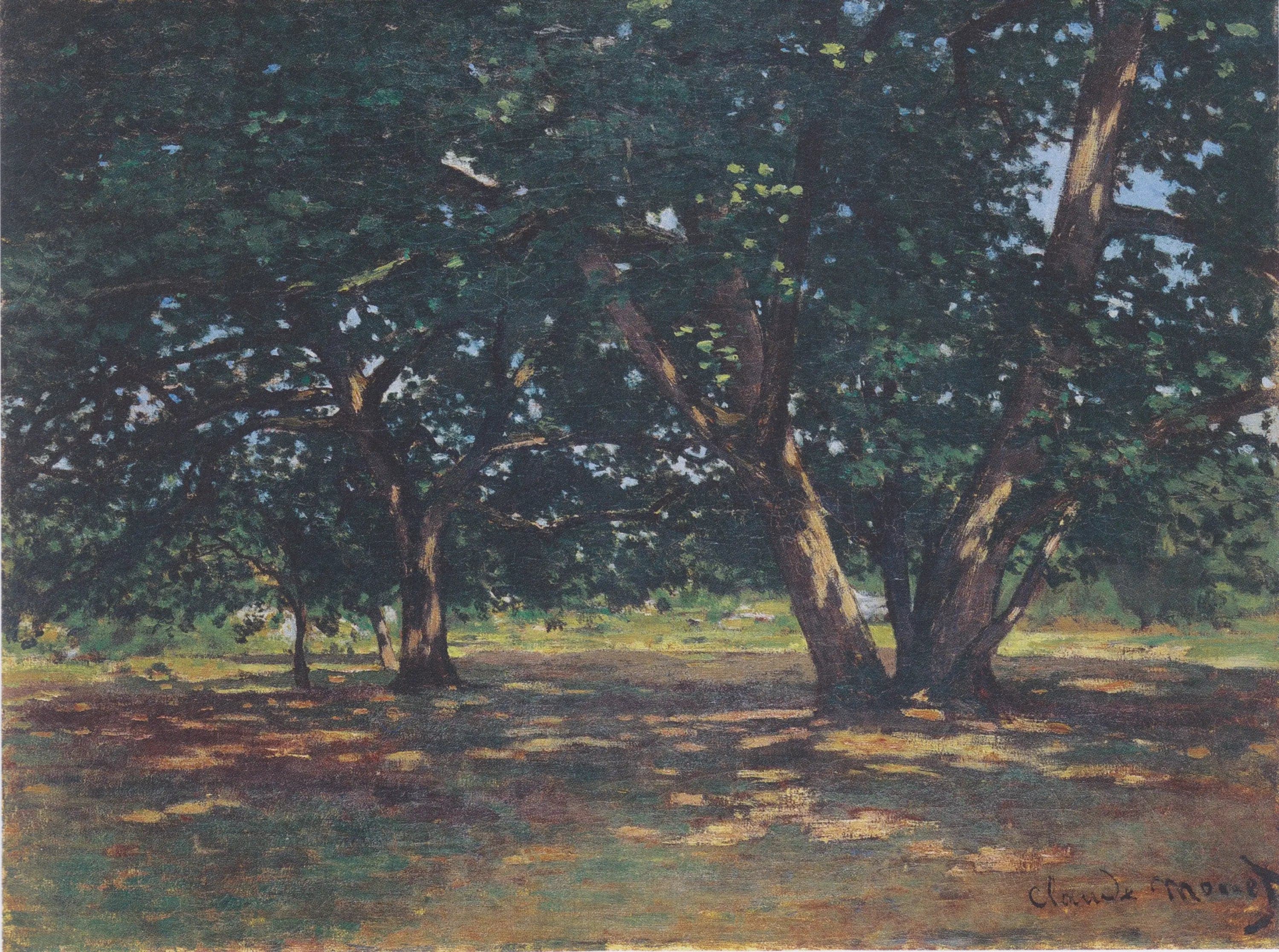
Forest of Fontainebleau
- Original dimensions
- 65 x 50 cm
- Museum
- building of the Winterthur Fine Arts Museum
- Year
- 1865
Scene depicted
This painting represents a striking view of the Forest of Fontainebleau, emblematic of the French landscape. Monet masterfully captures the light filtering through the foliage, the shimmering hues of the leaves, and the ambient tranquility that permeates nature. The composition, both gentle and rich in detail, invites a contemplative exploration of the treetops and the horizon illuminated by the sun's rays.
Historical context
Year: 1865 |BRK| Museum: building of the Winterthur Fine Arts Museum |BRK| Dimensions: 65 x 50 cm
Place in the artist's career
The painting “Forest of Fontainebleau” represents a turning point in Monet's career as he establishes his distinctive style. This masterpiece is part of a period of maturity, while also engaging in dialogue with revealing works such as “ Impression, Sunrise ” and “ Woman in a Garden ”. Each of these canvases reveals an evolution not only technical but also emotional, leading the viewer to experience nature in a new way.
Anecdote
“Nature is my greatest source of inspiration,” Monet might have declared while reflecting on his famous painting . Indeed, it was on a spring morning, as he breathed in the fresh air filled with the floral scents of the forest, that the idea for this canvas came to him. Each brushstroke testifies to this tireless quest to capture the fleeting beauty of the moment, an evocative force that resonates throughout the entire work.