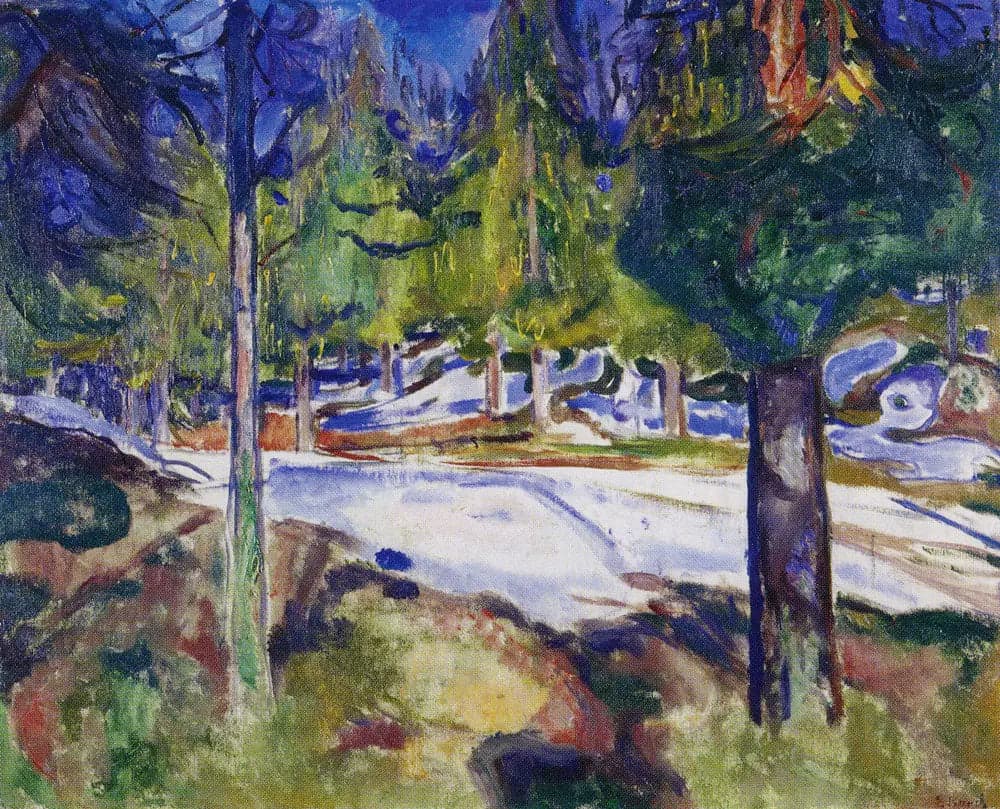
Forest
- Original dimensions
- 83 x 88 cm
- Museum
- Neue Nationalgalerie
- Year
- 1927
Scene depicted
In the painting "Forest - Edvard Munch ", the artist captures the magic and anxiety of a misty forest. The silhouettes of the trees rise majestically, standing like silent guardians amidst an almost dreamlike atmosphere. The composition ultimately illustrates the opposition between the calm of nature and the turmoil of the human soul, a recurring theme in Munch's work.
Historical context
Created in 1927, in the heart of Berlin, this painting is emblematic of the expressionist movement, of which Munch was one of the pioneers. The painting, currently exhibited at the Neue Nationalgalerie, is set against a historical backdrop marked by artistic and social upheavals, where the expression of emotions and individual psyche takes center stage. With its imposing dimensions of 83 x 88 cm, this canvas is truly captivating, inviting you to explore its depths and feel its nuances.
Place in the artist's career
This painting is part of a period of artistic maturity for Munch. After achieving success with works such as "The Scream" and "The Madonna," "Forest" reflects a stylistic evolution towards a more pronounced abstraction, integrating elements of dream and reality. It resonates with other paintings such as "The Dance of Life" and "The Burden of Life," where the artist continues his exploration of the human condition.
Anecdote
Munch once declared: "Art does not reproduce the visible; it makes visible what is not always present." Built on a misty morning, full of mystery, this masterpiece found its inspiration in a forest of striking beauty, where light plays with shadows, and where every breath of wind seems to whisper secrets of nature. This unique perception is at the heart of Munch's painting .