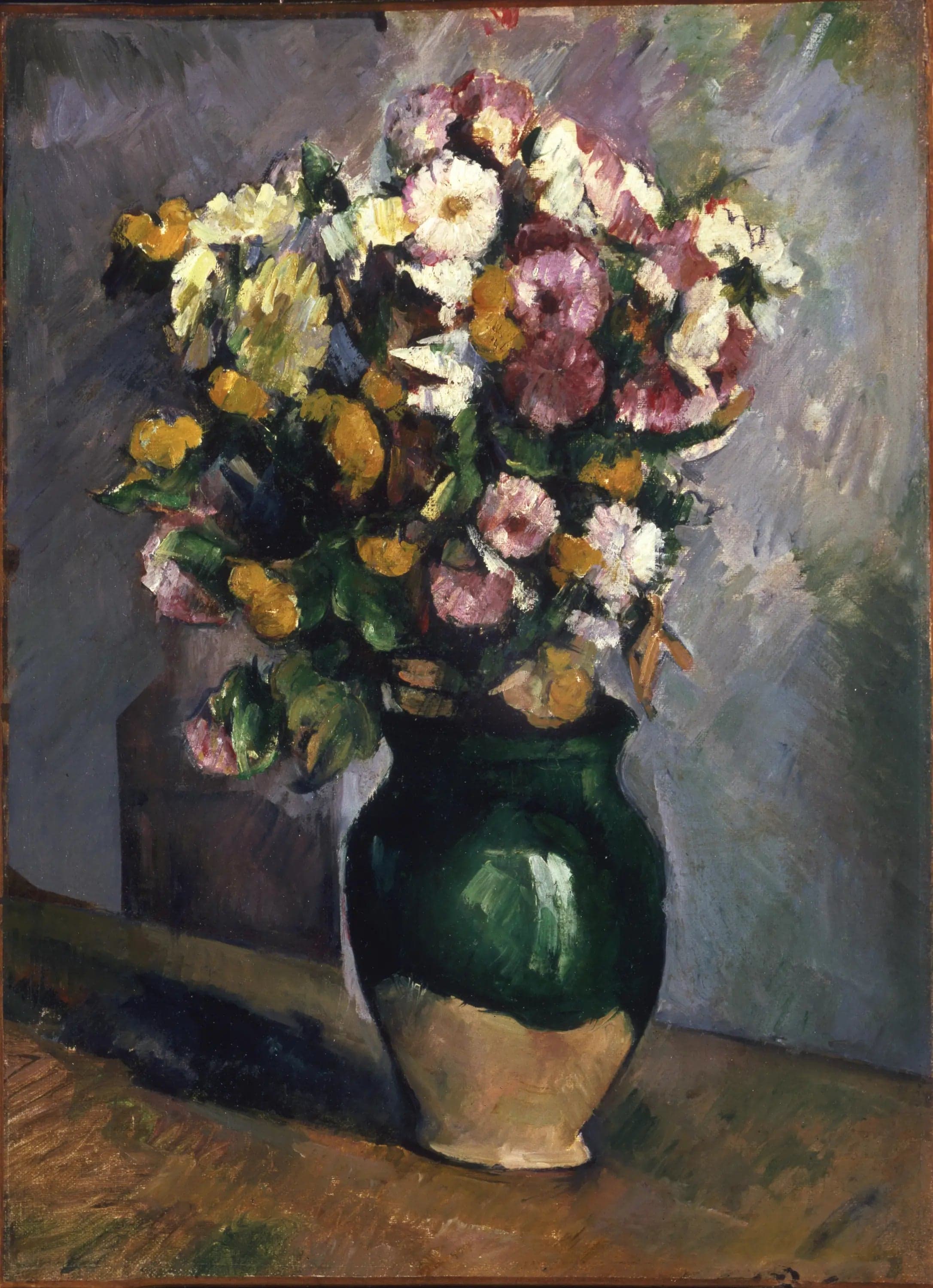
Flowers in an Olive Pot
- Original dimensions
- 34.3 x 46.3 cm
- Museum
- Philadelphia Museum of Art
- Year
- 1880
Scene depicted
The painting “Flowers in an Olive Pot” depicts a vibrant floral composition, delicately placed on a wooden table. The artist uses colorful flowers that seem to bloom effortlessly, while the olive pot adds a rustic dimension, evoking Mediterranean charm. This harmonious marriage evokes not only beauty but also the temporality of the seasons, drawing the eye and captivating the mind.
Historical context
Created in 1880, this painting emblematic of Paul Cézanne captures the essence of Provençal nature. At that time, Cézanne was part of the Impressionist movement while beginning his own stylistic innovations, blending shadows and lights to bring life to compositions that combine simplicity and depth. The painting is now located at the Philadelphia Museum of Art , where its dimensions of 34.3 x 46.3 cm still resonate with the powerful legacy of the artist.
Place in the artist's career
This painting is situated at a turning point in Cézanne's career, between the early Impressionist explorations and his quest for structured depth. Alongside works such as “The Large Bathers” and “Mont Sainte-Victoire,” this work reflects a technical evolution, from fluidity to geometry, marking a true stylistic peak.
Anecdote
“Nature is a living work ; it inspires me at every moment,” Cézanne reportedly said during a walk in his garden on a gentle spring morning. Through the painting of flowers, he translates an emotion of ephemeral innocence and a natural connection, linking the viewer to the very essence of life.