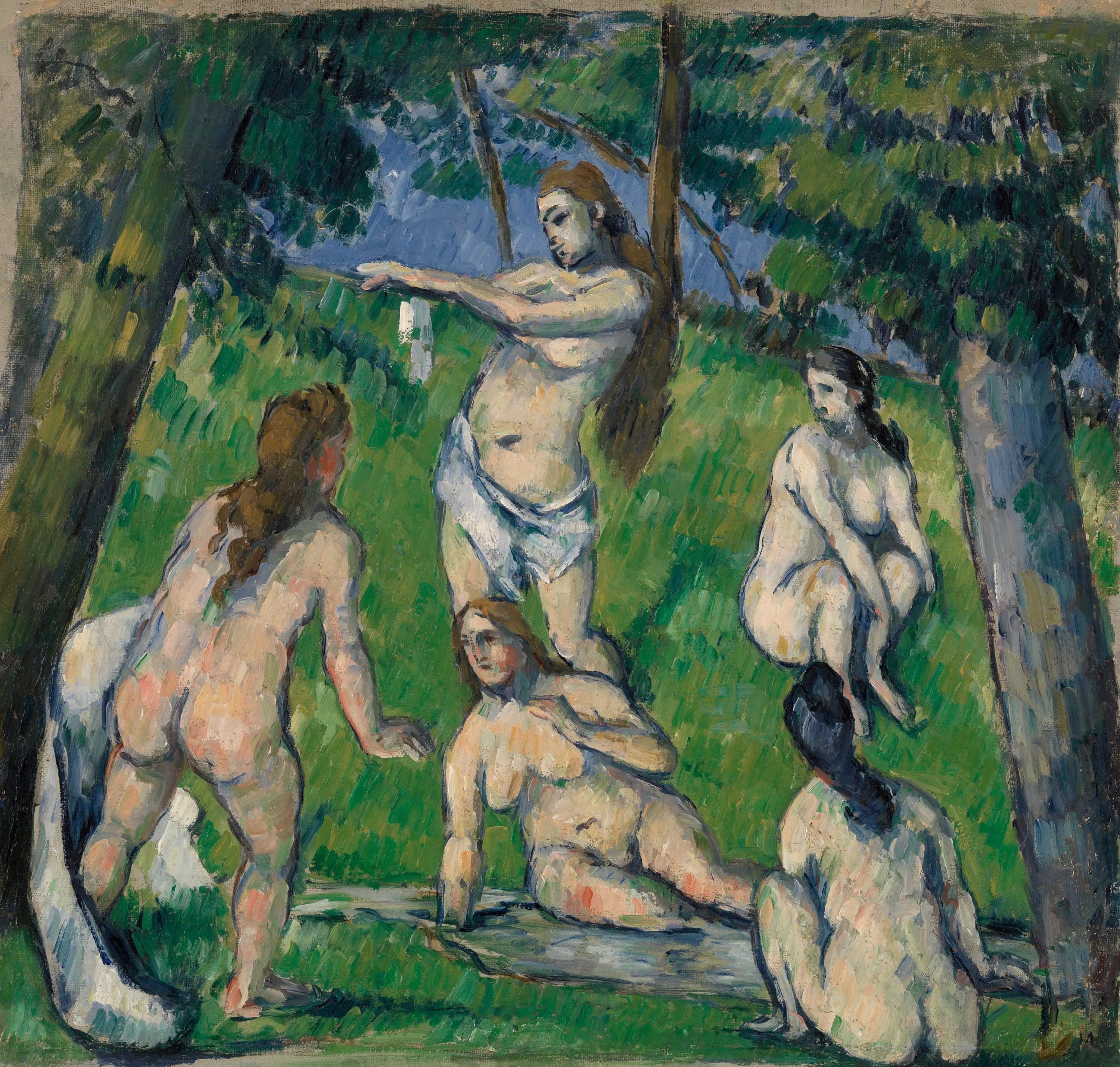
Five Bathers
- Original dimensions
- 38.1 x 34.6 cm
- Museum
- Detroit Institute of Arts
- Year
- 1879
Scene depicted
The painting "Five Bathers" illustrates a peaceful scene where man and nature coexist in harmony. The figures gracefully stand out against a backdrop of vibrant greenery, a fleeting moment frozen in eternity. The composition invites one to dive into the essential, the authenticity of human emotions translated by the purity of water and the light of a radiant summer day. This painting captures not only moments of rest but also an introspective depth, offering a sensitive view of the human condition.
Historical context
Created in 1879, during the early days of the Impressionist movement, the painting "Five Bathers" reveals itself in the picturesque setting of Aix-en-Provence, an iconic city in the south of France. It is in this bright and vibrant atmosphere that Paul Cézanne , an emblematic figure of modern art, draws inspiration from the beauty of landscapes and bodies in motion. Since then, this canvas has found its place in the precious collection of the Detroit Institute of Arts , where it stands out with its dimensions that captivate the eye and invite contemplation.
Place in the artist's career
"Five Bathers" marks a key milestone in Cézanne's career, illustrating his transition from an academic style to a more free and personal expression. It fits into a period of artistic maturity, where the artist explores themes such as landscape and the human figure, recalling the emotions present in his earlier works such as "The House of Pinède" and "The Card Players," and echoing the experimentation that would follow, culminating in his later compositions.
Anecdote
"Painting is a journey, a quest for truth," Cézanne is said to have remarked one April morning while sketching this masterpiece by the riverbank. This inspiration, evoked by the gentle murmur of the waters and the song of the birds, is felt in every brushstroke of the canvas , revealing the profound simplicity of nature and its mysterious harmonies.