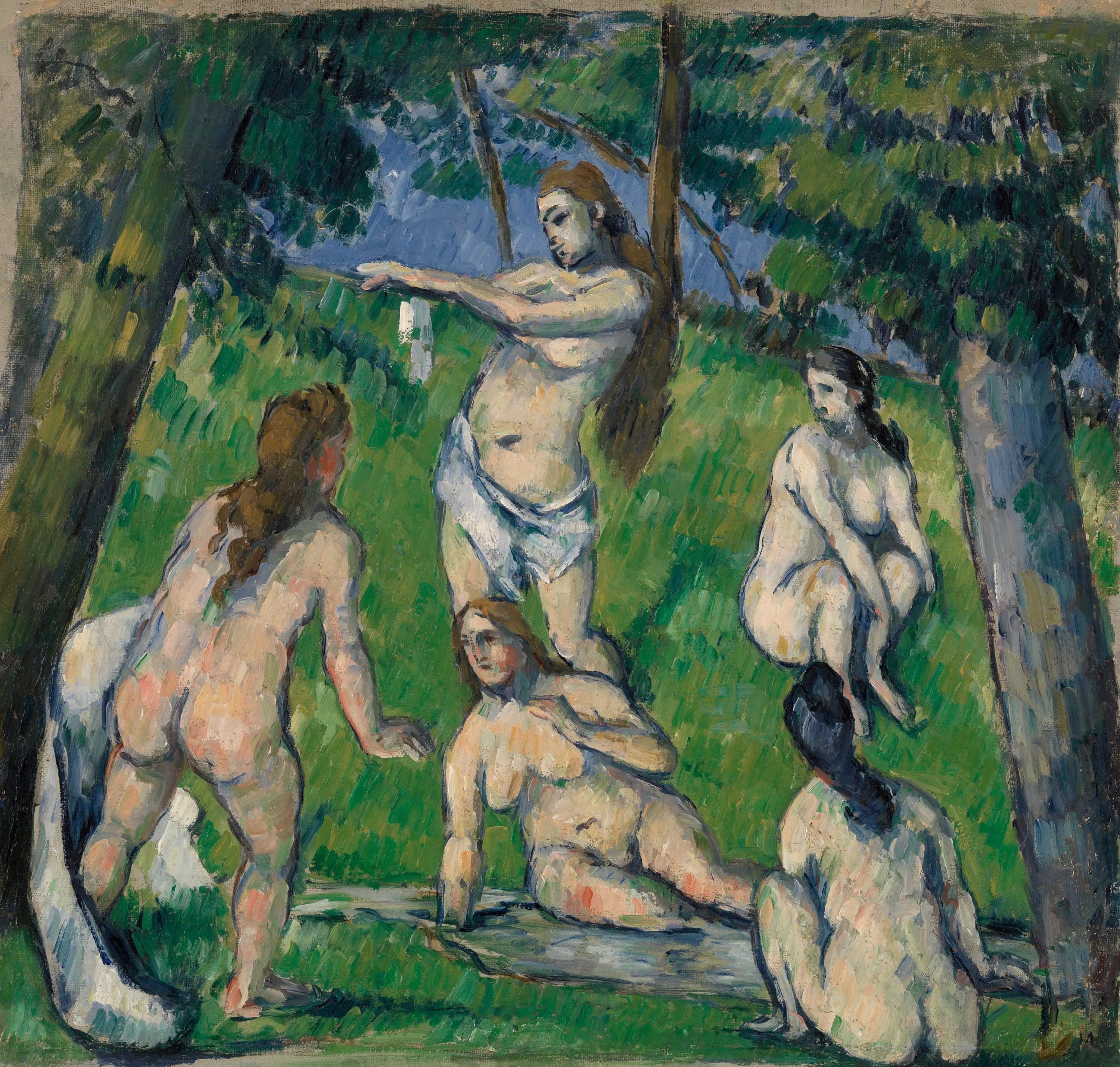
Five Bathers
- Original dimensions
- 42.9 x 40.6 cm
- Museum
- Barnes Foundation
- Year
- 1877
Scene depicted
In this pictorial work, Cézanne captures the intimacy and joy of women bathing, surrounded by lush vegetation. Each silhouette is carefully arranged to create a harmony of shapes and colors, where nature and humanity converge. The figures, although stylized, evoke a sensual beauty, full of life and spontaneity.
Historical context
Created in 1877, in Aix-en-Provence, this iconic painting embodies the transition to modernism and belongs to the post-impressionist movement. It is in the summer warmth of southern France that Cézanne, an unyielding student of form, painted this canvas to capture the very essence of the human body in harmony with nature. Today, the painting is housed at the Barnes Foundation , a precious collection of major works.
Place in the artist's career
Cinq baigneuses marks a turning point in Cézanne's career, reflecting his bold approach and his quest for the essence of form. Alongside famous paintings such as Les Joueurs de cartes and La Montagne Sainte-Victoire, this canvas reveals a technical evolution, from realistic representation to a prophetic abstraction, leading to his status as a master of modern art.
Anecdote
“Art is not an imitation of nature, but a reinvention,” Cézanne might have said as he contemplated this painting. Imagine a radiant morning, the sunlight dancing on the waters, while the bathers indulge in the summer softness, their laughter mingling with the rustle of leaves. This moment, imbued with serenity, gave birth to the living force of Cinq baigneuses.