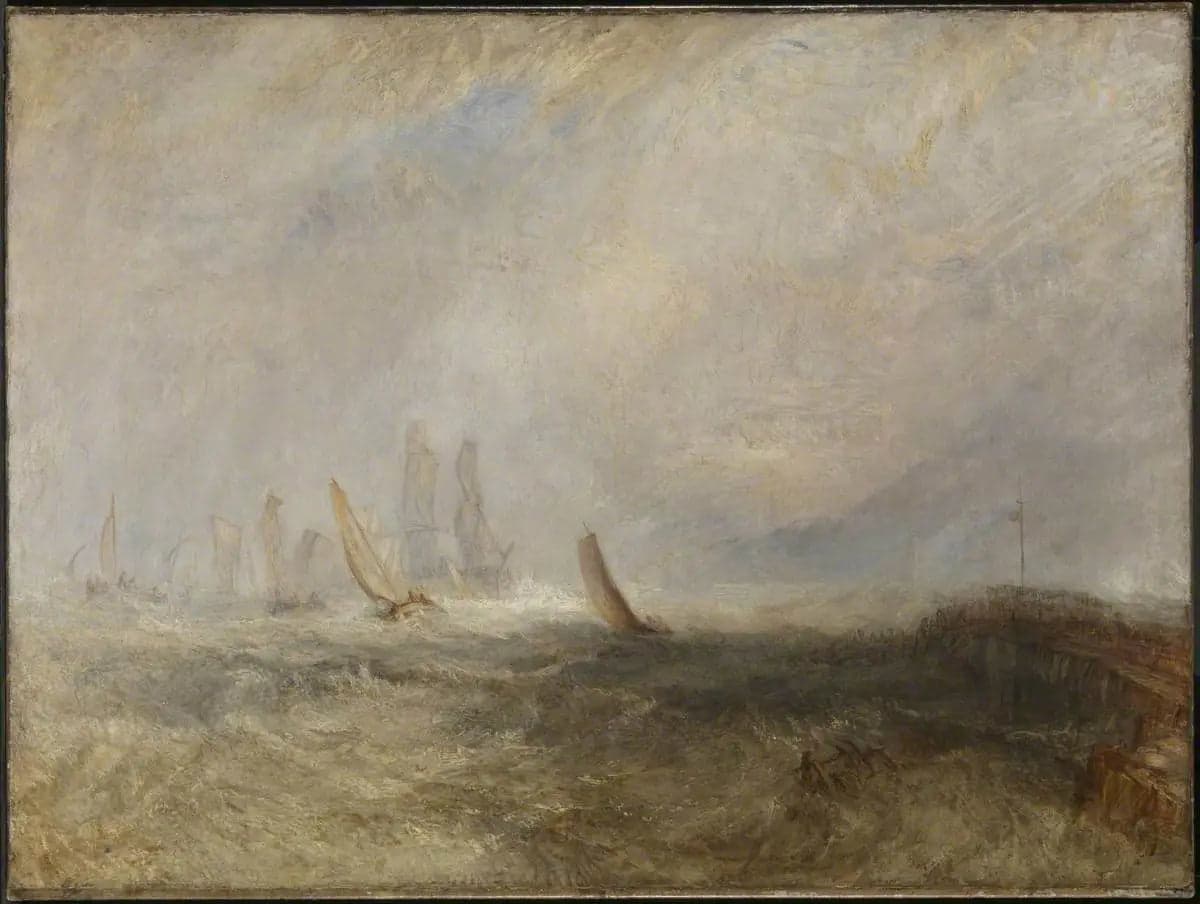
Fishing Boats Bringing a Disabled Ship into Port Ruysdael
- Original dimensions
- 91.4 x 123.2 cm
- Museum
- Tate
- Year
- 1844
Scene depicted
The painting evokes a poignant scene of a port, with fishing boats coming together to bring in a distressed ship. The human figures, brave and focused, bustle in a ballet of determination, while the tumultuous waters reflect a changing light, symbolizing hope and struggle. The scene is not only a maritime representation but also a metaphor for human solidarity in the face of adversity.
Historical context
Created in 1844, this painting embodies the artistic greatness of Joseph Mallord William Turner during the Romantic period in England. It was in London, at the heart of innovative artistic movements, that the canvas was born, rooted in a context where maritime landscapes captured the public's imagination. Today, the work is housed at the Tate , where its scale, measuring 91.4 by 123.2 cm, fascinates visitors.
Place in the artist's career
This painting marks an important milestone in Turner's artistic evolution. It is situated in his maturity period, where he experimented more with light and movement. When compared to works such as "The Fighting Temeraire" and "Rain, Steam and Speed," one can perceive how Turner continuously integrated his emotions into his canvases , thus evolving towards new expressive atmospheres.
Anecdote
Turner once declared: "Nature is my greatest teacher." On a misty morning by the Thames, he captured the living essence of fishing boats and shore workers, a memory etched in his mind, a source of inspiration for this masterpiece . The movement of the waves and the whispers of the wind set the rhythm for his creation, while the light played in the sky, bringing a mystical dimension to his canvas .