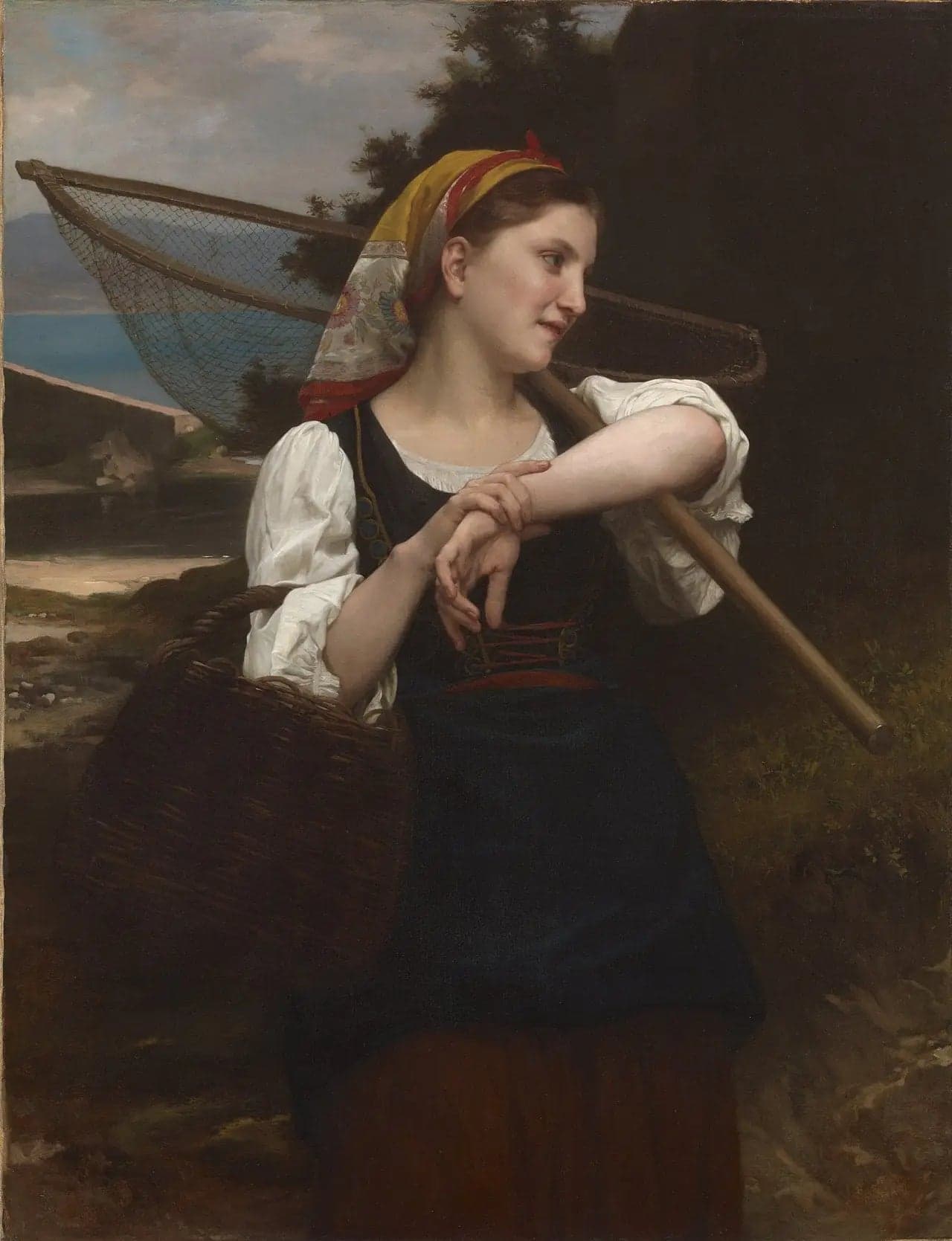
Fisherwoman
- Original dimensions
- 87.5 x 116 cm
- Museum
- Tokyo Fuji Art Museum
- Year
- 1872
Scene depicted
In this canvas , Bouguereau brilliantly depicts a young woman, barefoot in the water, capturing a moment of peace and simplicity. The reflections of the sun in the water add a dreamy dimension to this vibrant painting , where every detail tells a story of harmony with nature. The softness of her expression and the brilliance of the light transform this ordinary scene into a celebration of life.
Historical context
Created in 1872 in the artistic city of Paris, this painting , emblematic of the neoclassical movement, represents a turning point in the evolution of pictorial art in the 19th century. Fisherwoman stands out for its delicacy, capturing the beauty and naivety of a fleeting moment in rural life. Today, this canvas is preserved at the Tokyo Fuji Art Museum , where it continues to inspire visitors with its imposing dimensions of 87.5 x 116 cm.
Place in the artist's career
Fisherwoman is a beacon in the career of William-Adolphe Bouguereau , reaching a stylistic peak by showcasing his impeccable technique and love for feminine subjects. In parallel, other canvases such as The Virgin and Child and The Little Fishermen illustrate his expertise, demonstrating an evolution towards an ever more evident emotional depth in his work.
Anecdote
“Every brushstroke elevates reality, transforming it into a pictorial work vibrant with emotion,” said Bouguereau. One sunny morning, while walking along the shore, he spotted a young girl bending down to fish at the water's edge. This instantaneity nourishes the painting and lives on in the composition of this masterpiece , inviting the viewer to feel the tranquility of such a scene.