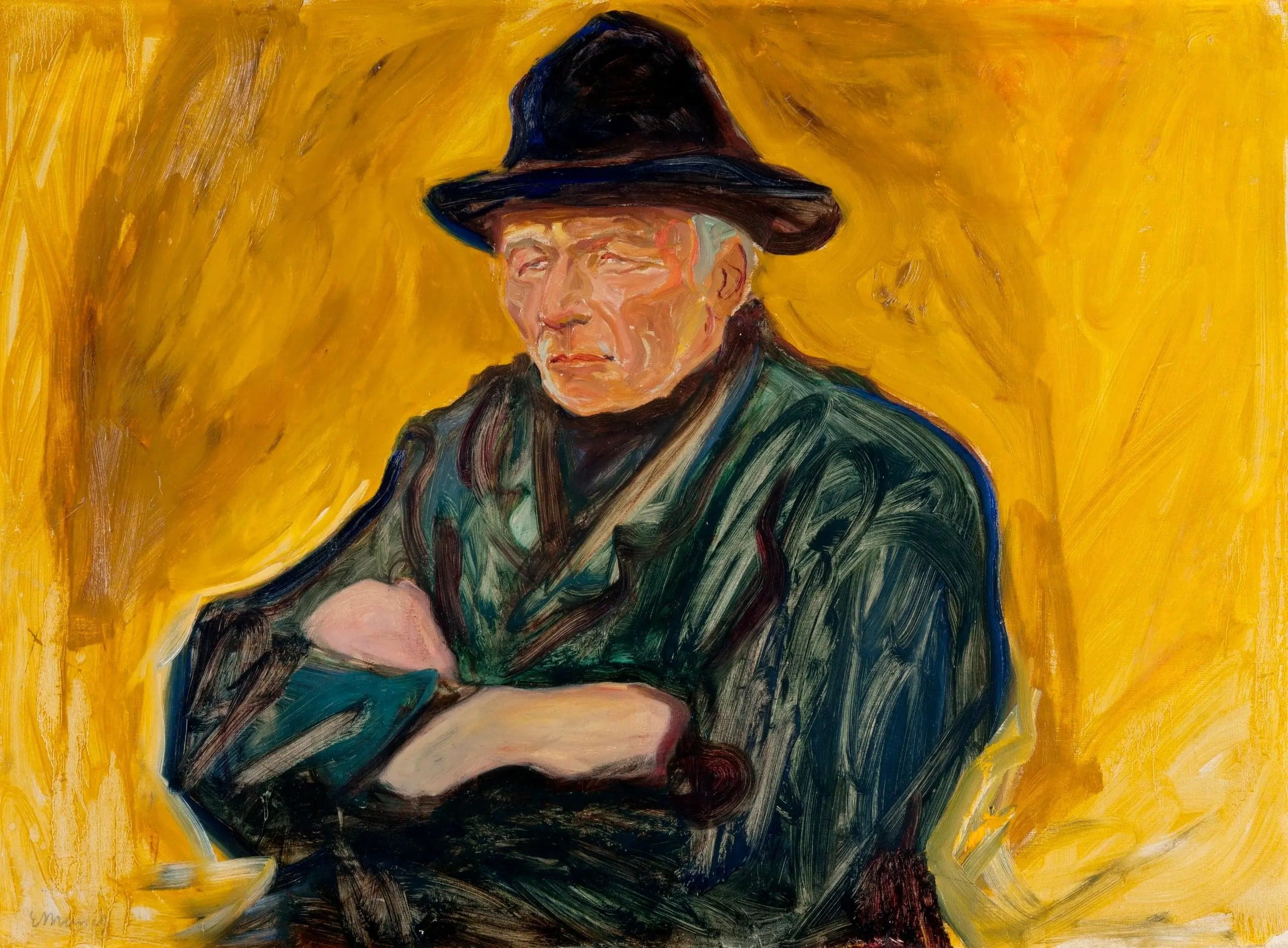
Fisherman on a Yellow Background
- Original dimensions
- 96 x 70.5 cm
- Museum
- Wernerska villan
- Year
- 1902
Scene depicted
In this canvas , Edvard Munch captures a moment of serenity: a fisherman stands facing a vast horizon, surrounded by a golden light that illuminates his daily life. This suspended moment evokes both solitude and inner peace, an invitation to contemplation in the face of the immensity of nature.
Historical context
Created in 1902 in the city of Oslo, Norway, this painting is emblematic of the Symbolist movement, a period when Munch explores the depths of the human soul. This canvas , exhibited at the Wernerska villan museum, captures the essence of an era where introspection and individuality take center stage.
Place in the artist's career
Fisher on a Yellow Background represents a turning point in Munch's career, marking the beginning of a period of deeper sensory exploration. It is positioned between The Dance of Life and The Scream, two other canvases that showcase the emotional richness of his work, illustrating his ability to capture both anguish and tranquility.
Anecdote
Edvard Munch once stated: “Painting is for me a means of expressing my deepest emotions.” One spring morning, while contemplating a solitary fisherman against a golden background, he was struck by the harmony between man and nature. This fleeting moment transformed into a vivid work of art , where each stroke of paint is imbued with this ephemeral revelation.