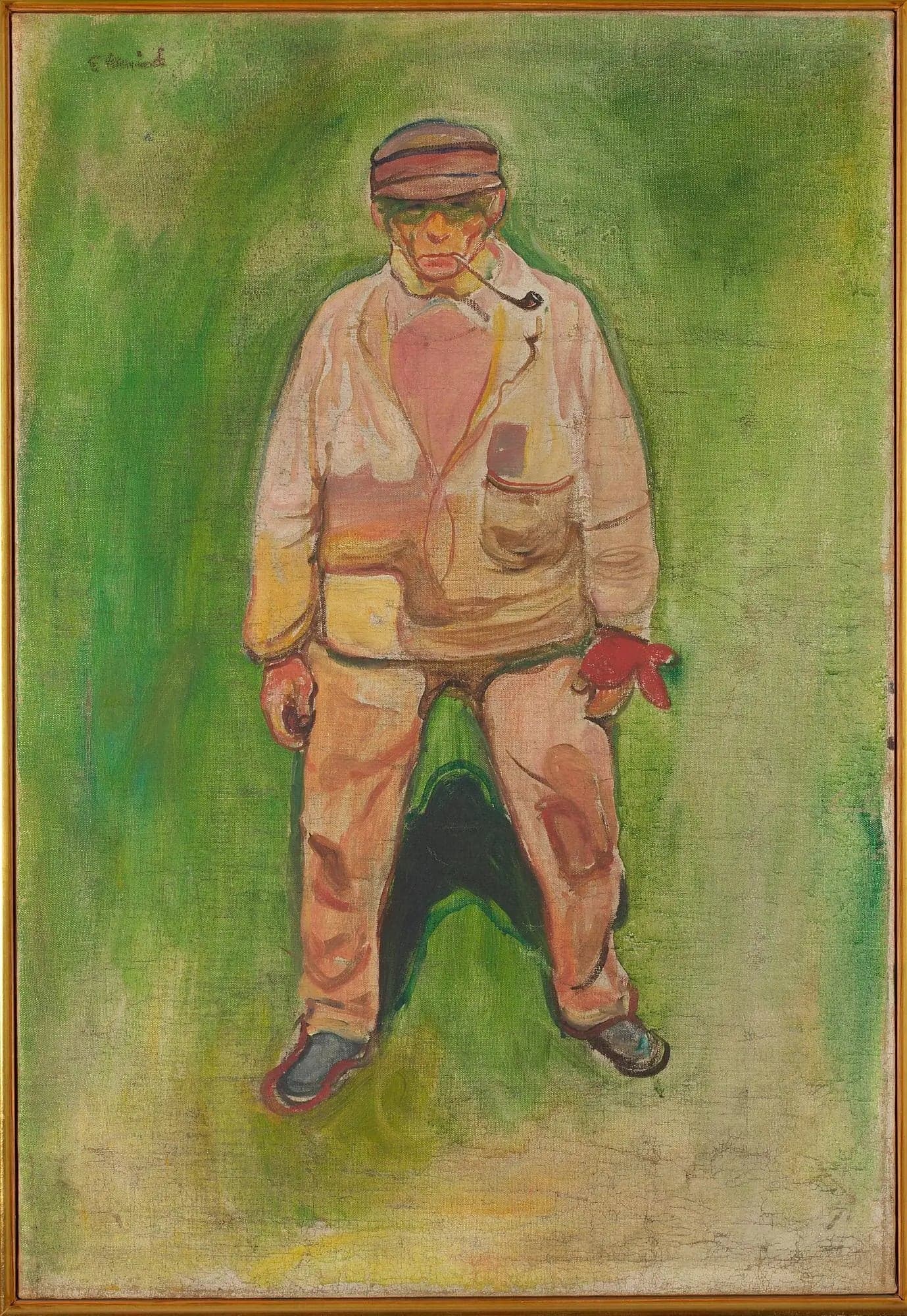
Fisherman on a Green Meadow
- Original dimensions
- 61.5 x 89 cm
- Museum
- Munch Museum
- Year
- 1902
Scene depicted
The painting “Fisher on a Green Meadow” depicts a man, a peaceful silhouette facing a lush nature. In this serene scene, the fisherman seems suspended in time, capturing the moment of contemplative solitude. The vibrant colors and fluid shapes testify to a landscape imbued with poetry, where the everyday and art meet.
Historical context
Created in 1902, this iconic work was born in the lush greenery of Norway, where Edvard Munch , a leading figure of the expressionist movement, captured the ephemeral beauty of nature. The painting, currently displayed at the Munch Museum in Oslo, offers a window into a time when art intertwines with life, immersing the viewer in a world of vibrant sensations.
Place in the artist's career
This painting is part of a period of maturity for Munch, where his unique style flourishes. When compared to works such as “The Scream” and “The Madonna,” one observes a technical evolution where emotional tension intensifies, while maintaining an unparalleled pictorial harmony. “Fisher on a Green Meadow” thus becomes a crucial step in appreciating the richness of his artistic journey.
Anecdote
“Nature speaks to him in a thousand ways, it whispers to his soul.” These words of Edvard Munch resonate in the inspiration that led him to immortalize this fleeting moment on canvas. In the heart of a sunny morning, on a green meadow, he captured the very essence of tranquility. The painting thus becomes an echo of this communion between man and earth.