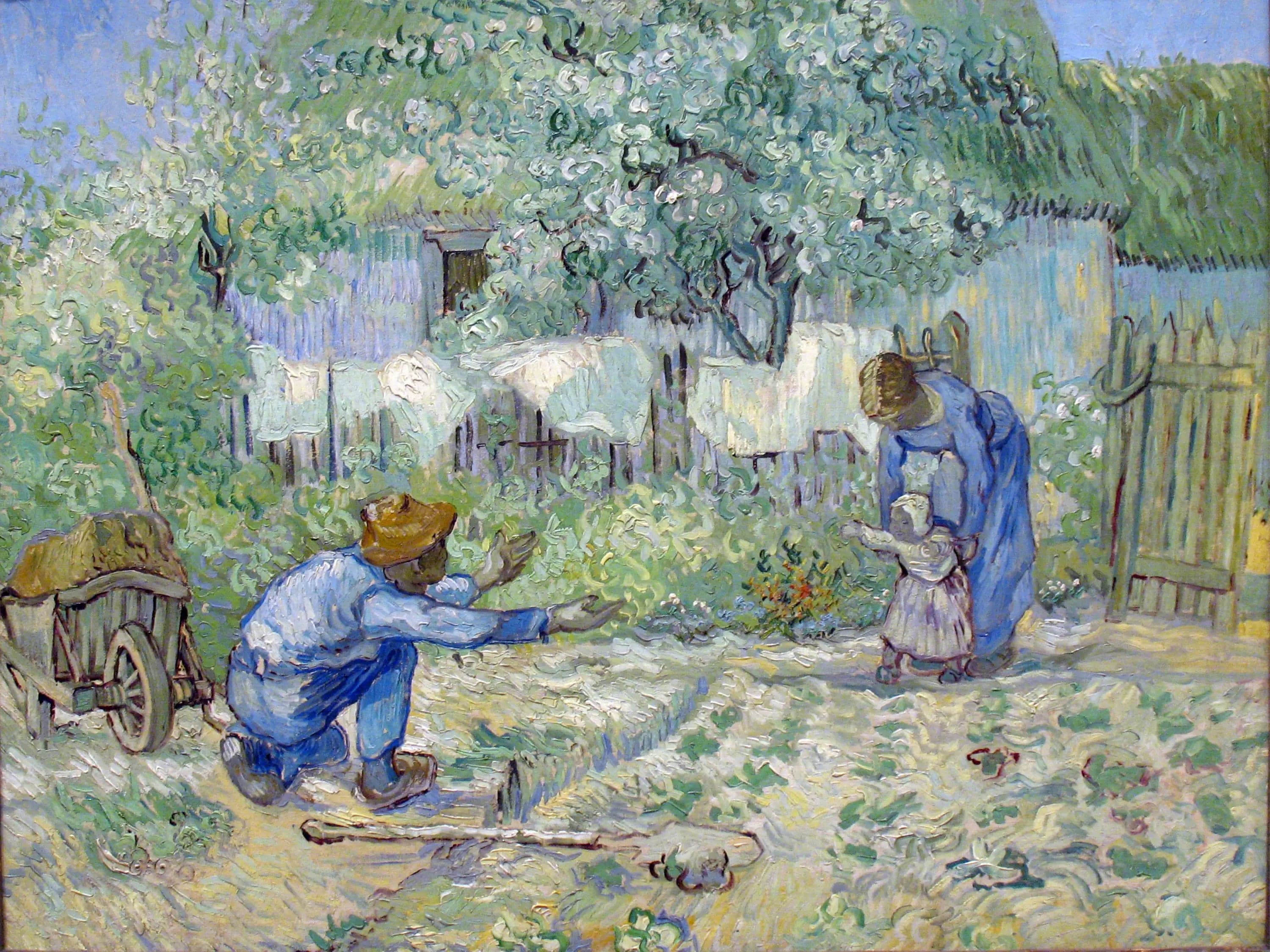
First Steps, after Millet
- Original dimensions
- 91.1 x 72.4 cm
- Museum
- Metropolitan Museum of Art
- Year
- 1890
Scene depicted
In this charming scene, children, hands linked and innocent laughter, are depicted in a vibrant nature. Their dynamic embodies innocence and the first explorations of the world around them. This painting is a kind tribute to childhood, where every detail conveys the thrill of discoveries, the scents of fresh grass, and the glow of the first rays of sunlight. Through its playful black and white of colors, Van Gogh manages to transform the ordinary into the extraordinary.
Historical context
Navigating through the artistic effervescence of the late 19th century, First Steps, after Millet embodies Vincent van Gogh's late respect for Vincent van Gogh for peasant realism , while revealing the post-impressionist sensitivity that is uniquely his. This painting is a bridge between the shadow of rural realities and the vibrant light of human emotions. The canvas is preserved at the prestigious Metropolitan Museum of Art , where it continues to evoke admiration and contemplation.
Place in the artist's career
First Steps, after Millet fits into Van Gogh's maturity period, a pivotal time in his artistic journey. Let’s compare this canvas to The Starry Night , with its turbulence and dream, and to The Sunflowers , which celebrates ephemeral beauty. Together, these works trace a fascinating path through emotional transformation and the depth of his canvas .
Anecdote
In a creative surge, Van Gogh might have written: “Every brushstroke on this canvas is a step towards freedom.” Inspired by the flows of agricultural life, he would have observed children taking their first steps in a blooming field, a scene imbued with innocence and promise. The painting becomes a reflection of an emergence, an awakening, as lived experience marries technique, elevating First Steps to the rank of masterpiece .