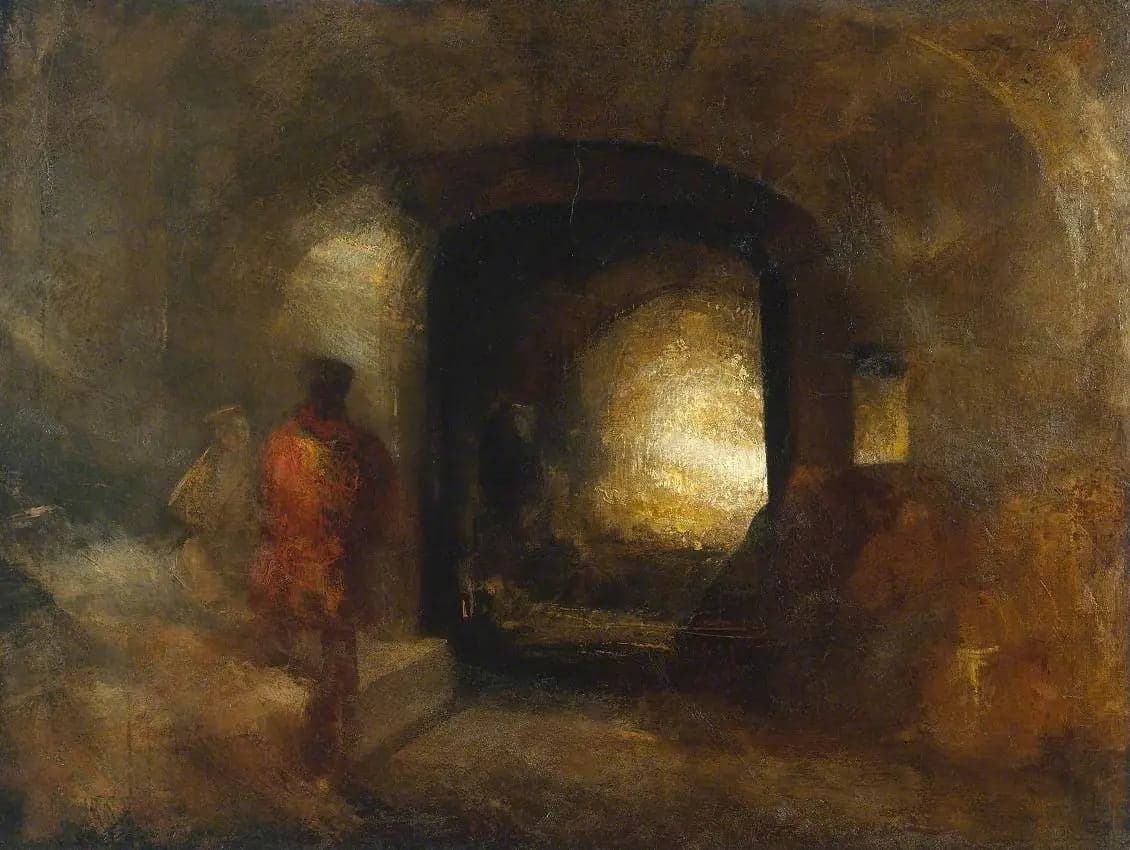
Figures in a Building
- Original dimensions
- 91.4 x 121.9 cm
- Museum
- Tate
- Year
- 1832
Scene depicted
In Figures in a Building , Turner offers us not only an architectural landscape but also an exploration of the relationship between man and the environment. Figures emerge here and there, highlighting human interaction in a transformed space. The painting becomes a witness to an era in transition, where each brick tells a story.
Historical context
It was in 1832, in the heart of London, that Figures in a Building was born, placing Turner in the romantic movement that was revolutionizing art. In this context where the city is transforming and modernizing, this painting presents itself as a snapshot of architectural and social upheavals. Currently exhibited at the Tate , this captivating canvas , with its generous dimensions, resonates with a nostalgic and poetic echo of times past.
Place in the artist's career
This painting marks a turning point in Turner’s career, moving from realism to a lighter, more luminous abstraction. Compared to The Fighting Temeraire and Rain, Steam and Speed , this canvas reveals an evolution in his technique, emphasizing the effects of light and atmosphere.
Anecdote
“Light is everything, and shadow, my soul.” This moment when Turner stops to admire the play of shadows on a facade, perhaps on a misty morning, is the origin of the evocative power of Figures in a Building . The inspiration, caught in a breath of fresh air, is enriched by the sobriety of London’s alleys.