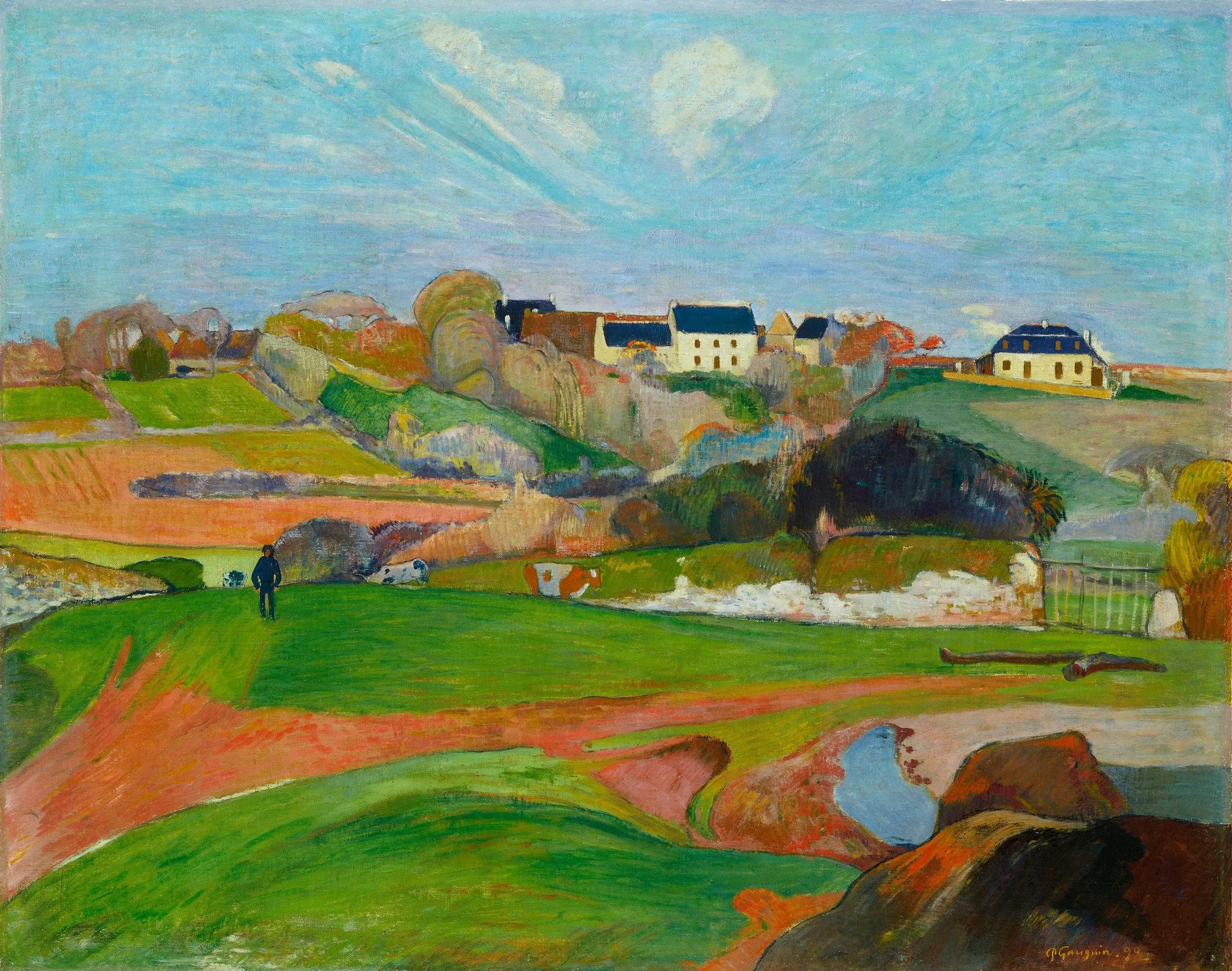
Fields at Pouldu, or Landscape at Pouldu
- Original dimensions
- 92.4 x 73.3 cm
- Museum
- National Gallery of Art
- Year
- 1890
Scene depicted
The painting “Champs au Pouldu, ou Paysage au Pouldu” offers a vast view of the rolling fields bathed in golden light, where vibrant colors blend with the dynamic strokes of Gauguin's brush. One can see the sea wishing to dance with the wind, while the fields seem to tremble under a gentle sun. This harmony between land and sea reveals a fragile, almost dreamy balance that transports the viewer away from daily concerns.
Historical context
Created in 1890, this painting emblematic finds its roots in the charming commune of Pouldu, in Brittany, France. It is the fruit of the post-impressionist period where Paul Gauguin , master of color and form, explores the vibrant landscapes and hearts awakening to simple beauty. Today, this canvas is located at the National Gallery of Art , where art enthusiasts can admire its grandeur, measuring 92.4 by 73.3 cm.
Place in the artist's career
“Champs au Pouldu” is situated at a crossroads in the career of Paul Gauguin . It reflects a style in full evolution, where the artist moves away from the linear motifs of impressionism to embrace a more symbolist representation of nature. In the era of his other notable works such as “Vision after the Sermon” and “The Women of Tahiti,” this canvas bears witness to a journey towards emotional depth and a bold palette, thus forging his artistic legacy.
Anecdote
“I wanted, through this canvas , to capture the essence of a moment of life. One sunny morning, as the sound of the waves mingled with the softness of the meadows, inspiration struck me like lightning.” These words beautifully summarize the delicate moment of the creation of this masterpiece . A scene imbued with natural beauty, within which the artist invites everyone to feel the magic of a world in communion with nature.