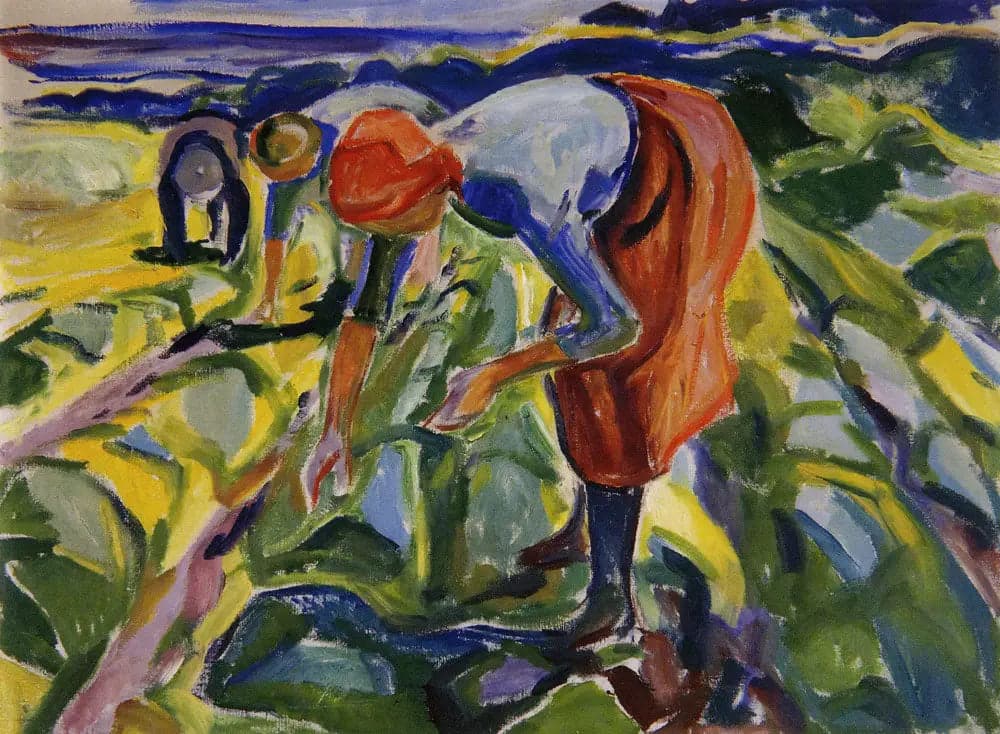
Field Work
- Original dimensions
- 135.5 x 100 cm
- Museum
- Not specified
- Year
- 1917
Scene depicted
The scene depicted in “Field Work” captivates with its authenticity and emotional depth. We see laborious figures, witnesses of raw humanity, busy in lush fields, under a vibrantly nuanced sky. The painting illustrates the coexistence between man and nature, a dance rhythmically marked by the effort and peace of the landscape. The movement of bodies and the richness of textures play a key role in this evocative composition.
Historical context
This painting a few years after World War I, immerses the viewer in the rural context of Norway, where Edvard Munch , one of the main representatives of symbolism and expressionism , captured the essence of a tumultuous era. This famous canvas highlights the life of the workers of the land, a vibrant echo of the social reality of his time. Currently, the work is not preserved in a specified museum, but its memorable and timeless dimension continues to inspire art lovers.
Place in the artist's career
“Field Work” stands at the heart of Edvard Munch 's artistic journey, reflecting his creative maturity. After works like “The Scream” and “The Madonna,” this painting reveals an evolution towards calmer scenes, integrating nature as a place of redemption. A striking contrast between anguish and serenity, it echoes his constant exploration of the human soul.
Anecdote
“In the detail, one finds the spirit of life.” said Munch, evoking the inspiration that lies behind this masterpiece . One spring morning, as the sun's rays gently pierced the cool air, he felt the energy and beauty of the fields, a moment that this canvas manages to immortalize brilliantly.