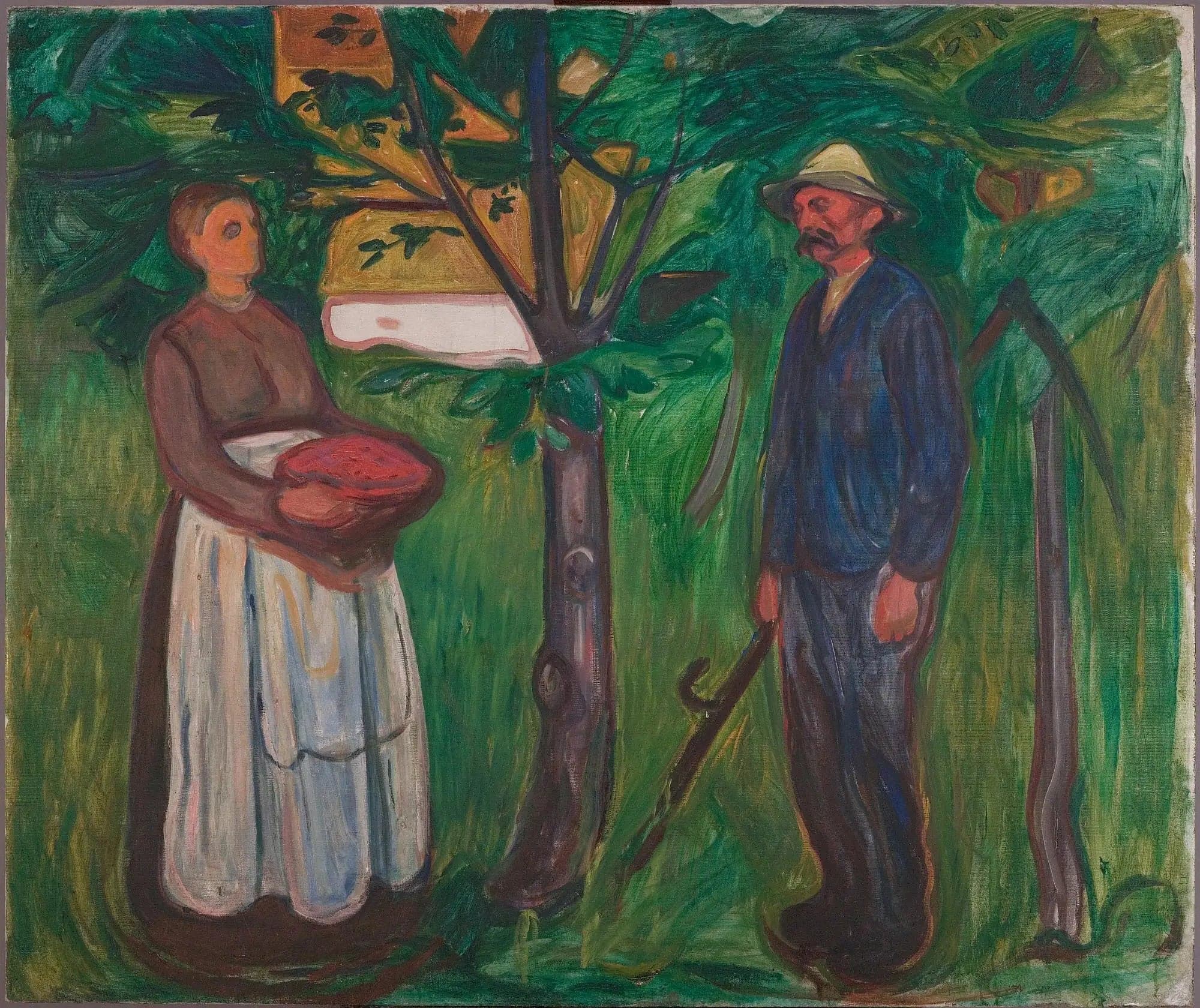
Fertility
- Original dimensions
- 140 x 120 cm
- Museum
- Not specified
- Year
- 1899
Scene depicted
The canvas "Fertility" is an ode to the beauty of nature and the richness of life. This painting, through its shapes and colors, evokes a palpable sensuality where the cycle of life intertwines with the tranquil strength of the nurturing earth. The viewer is drawn into a visual harmony, witnessing a tangible, almost organic fertility that resonates with universal feelings such as hope and renewal.
Historical context
Created at the end of the 19th century, during a period of artistic and cultural upheaval, the painting "Fertility" finds its roots in Oslo, Norway, the artist's homeland. Munch, a major figure of the expressionist movement, expresses an aesthetic deeply marked by symbolism . Currently, this iconic canvas is not displayed in a specific museum, which enhances its rare and intriguing character.
Place in the artist's career
Usually perceived as a pivotal period, the painting "Fertility" fits into a phase of stylistic diversity for Munch, where raw emotion and exploration of the human condition intertwine. When compared to his major works like "The Scream" and "The Madonna," one observes an evolution of his expressionism , shifting from melancholic introspection to a celebration of life, reflecting an artistic maturity.
Anecdote
"Life blooms in every breath," Munch is said to have declared during a spring walk, observing the vibrant nature around him. This moment of intense inspiration influenced the creation of his masterpiece , juxtaposing the cycles of life and nature. It is in the luminous softness of a flowering morning that he captured the intensity of the emotion inherent in the painting .