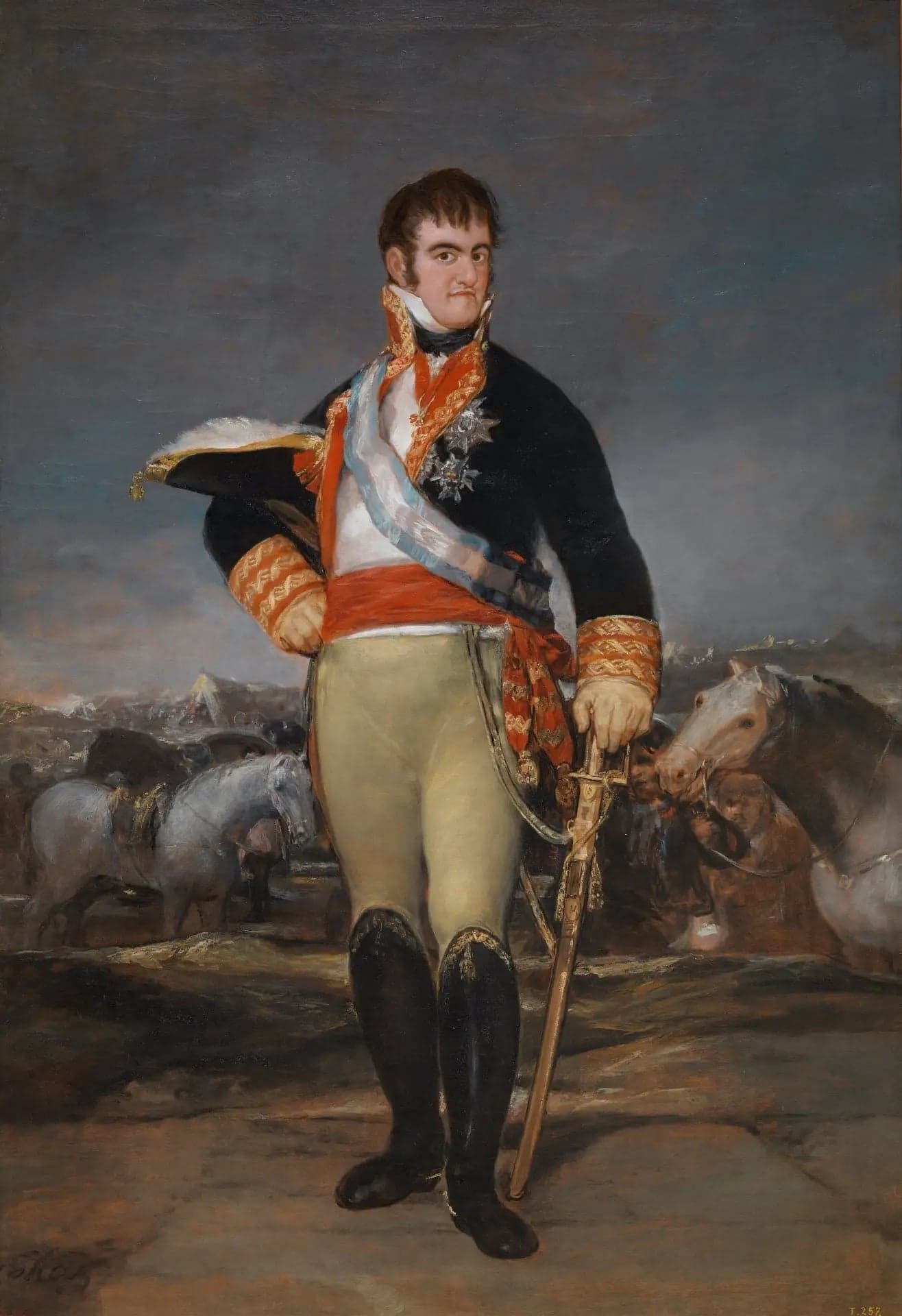
Ferdinand VII in a Camp
- Original dimensions
- 140 x 207 cm
- Museum
- Prado Museum
- Year
- 1815
Scene depicted
This painting depicts a captivating scene: Ferdinand VII, surrounded by his court, appears to be in deep introspection. The composition follows the king in his camp, illustrating military life and the political tensions of an era marked by war and change. The canvas resonates with the echoes of strategic discussions, the sounds of nature around, and the crackling of campfires under a starry sky.
Historical context
Created in 1815, the painting “Ferdinand VII in a Camp” is part of the romantic movement, reflecting a troubled period in Spanish history. Made in Madrid, this famous work is now housed in the Prado Museum, in the vibrant Spanish capital. With its imposing dimensions of 140 by 207 cm, this canvas captivates with its presence. It emerges in a context where Spain was experiencing political upheaval, and Goya, as a master, managed to capture the complexity of human emotions.
Place in the artist's career
“Ferdinand VII in a Camp” represents not only a stylistic peak in Goya's career but also sits between two other major works: “The Disasters of War” and “The Clothed Maja.” These paintings testify to an evolution both in technique and emotion; from the critique of power to the affirmation of a certain human nobility, Goya has managed to evolve while remaining true to his interpretation of human struggles.
Anecdote
“It took me several nights of reflection to capture the essence of human nobility.” This fictional quote from a moment of inspiration, in the calm of a misty morning, evokes the intensity with which Goya drew from his surroundings to create this masterpiece . The solemn gaze of Ferdinand VII, lost in thought, reflects this quest for meaning, through the prism of painting .