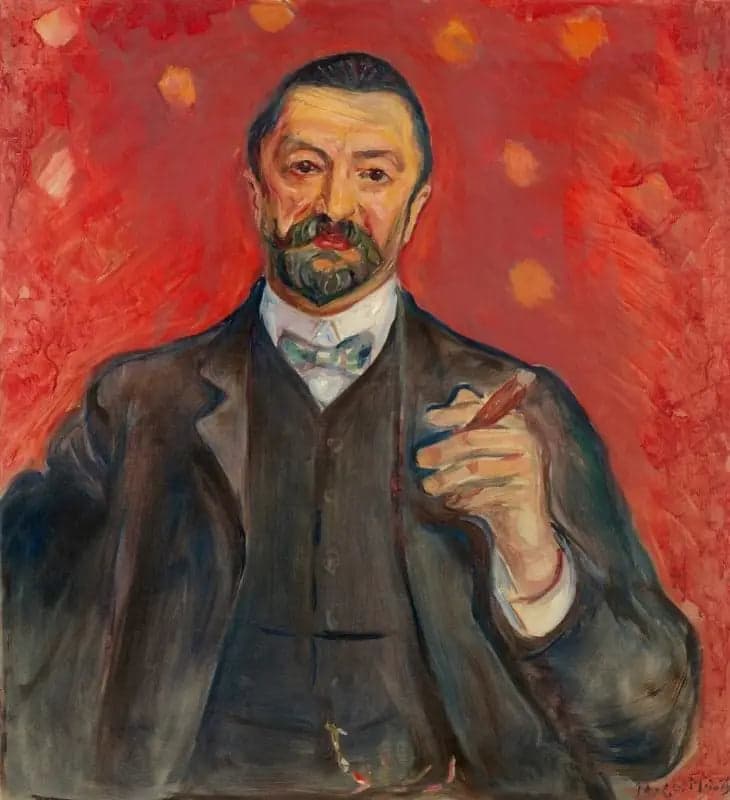
Félix Auerbach
- Original dimensions
- 77.1 x 85.4 cm
- Museum
- Van Gogh Museum
- Year
- 1906
Scene depicted
In this painting , Munch presents us with an intimate scene, a frozen moment where the gaze of a character in the throes of emotional intensity confronts the viewer. The ambient brightness and vibrant colors create an atmosphere charged with tension, going beyond mere representation to become an exploration of the solitude and anxiety inherent in human existence.
Historical context
Created in 1906, in the heart of Northern Europe, the painting "Félix Auerbach" reflects the influence of the symbolist and expressionist movements that marked this troubled era. It is in the vibrant city of Oslo that Munch, the voice of artistic modernity, captured raw emotions, thus outlining the contours of this iconic composition that is now housed in the Van Gogh Museum . Through its majestic dimensions of 77.1 by 85.4 cm, the work radiates like an open window to the human soul.
Place in the artist's career
"Félix Auerbach" marks a turning point in Munch's career, signifying his rise among the major figures of modern art. This painting is the pivot between works such as "The Scream" and "The Dance of Life," showcasing a refinement of his style and the emergence of a technical mastery of painting never seen before.
Anecdote
Edvard Munch once said: "Every painting is an invitation to dive into the unknown." It was on a spring morning bathed in soft light, in the bustling streets of Oslo, that inspiration struck him for this masterpiece . A face encountered on the way, a distant melody, everything blended to give birth to this painting where emotions echo.