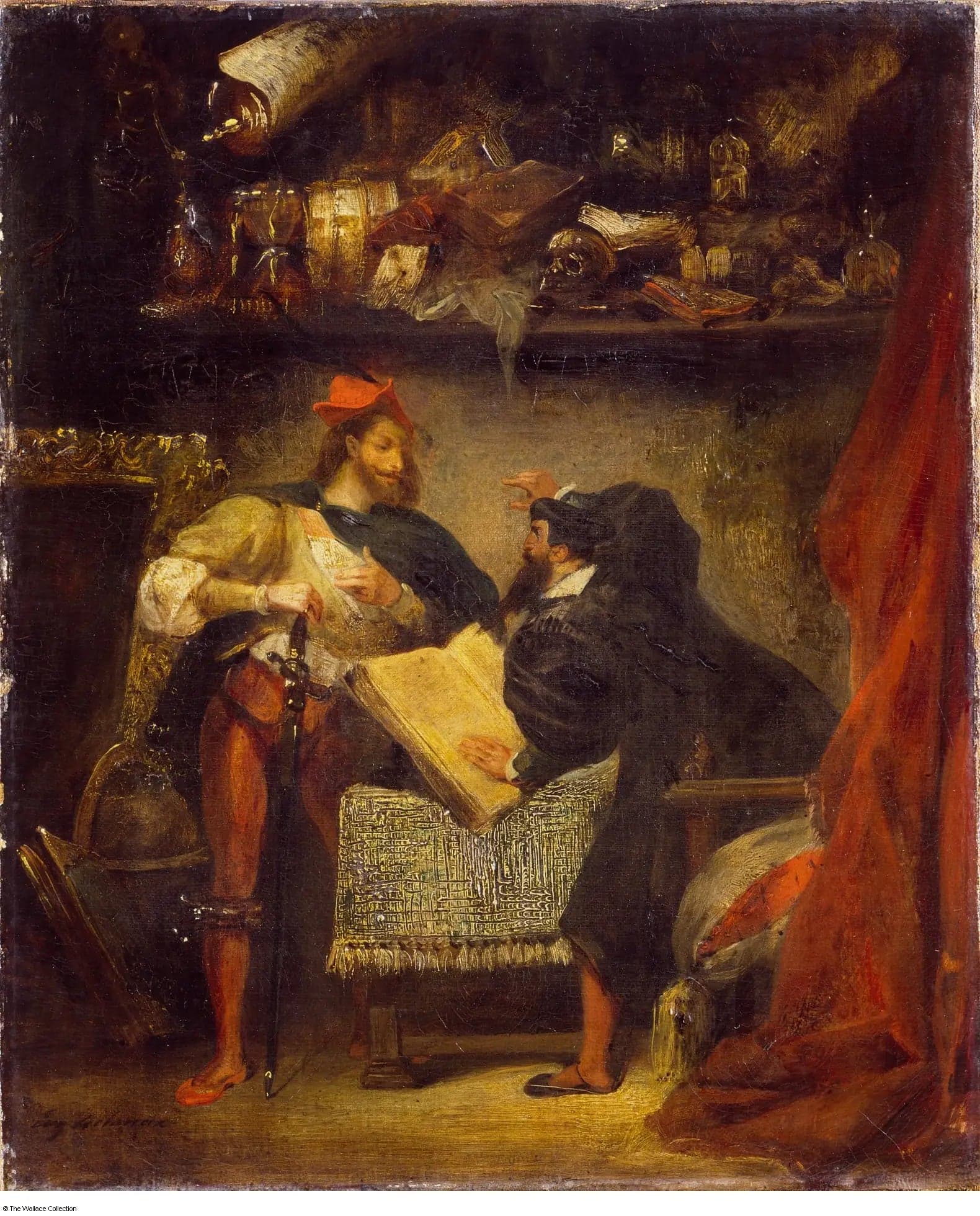
Faust and Mephistopheles
- Original dimensions
- 37.7 x 45.5 cm
- Museum
- Wallace Collection
- Year
- 1827
Scene depicted
This iconic painting illustrates the decisive moment when Faust, troubled by his thoughts and desires, meets Mephistopheles, the embodiment of the devil. On this canvas , the intensity of Faust's gaze, combined with the ever-present cunning of Mephistopheles, crystallizes the anguish and moral dilemma in which the protagonist finds himself. This visual dialogue between the two characters is both captivating and revealing of a deeply human inner struggle.
Historical context
Created in 1827, this painting is part of the romantic movement, characterized by its exaltation of emotions and landscapes. It was born in Paris, the epicenter of innovative ideas of the time, and is inspired by Goethe's famous character, Faust. Today, the canvas is part of the collections of the Wallace Collection, where it stands majestically, captivating visitors with its rich dimensions and deeply considered details.
Place in the artist's career
This painting , created at a key moment in Delacroix's career, marks a turning point towards stylistic maturity. It positions itself among other significant works such as “ Liberty Leading the People ” and “ The Massacre at Chios ,” showing a constant evolution towards the expression of strong emotion and a poignant representation of the romantic movement.
Anecdote
“Human passion is a backdrop, and each emotion a color,” said Eugène Delacroix , thus evoking the essence of his masterpiece . It was on a warm summer morning, amidst the hustle and bustle of Paris, that he described his vision of Faust, influenced by the books and the lights dancing on the cobblestones. This touching and vibrant inspiration is embodied in the narrative strength of the painting .
Major exhibitions
Salon of 1827