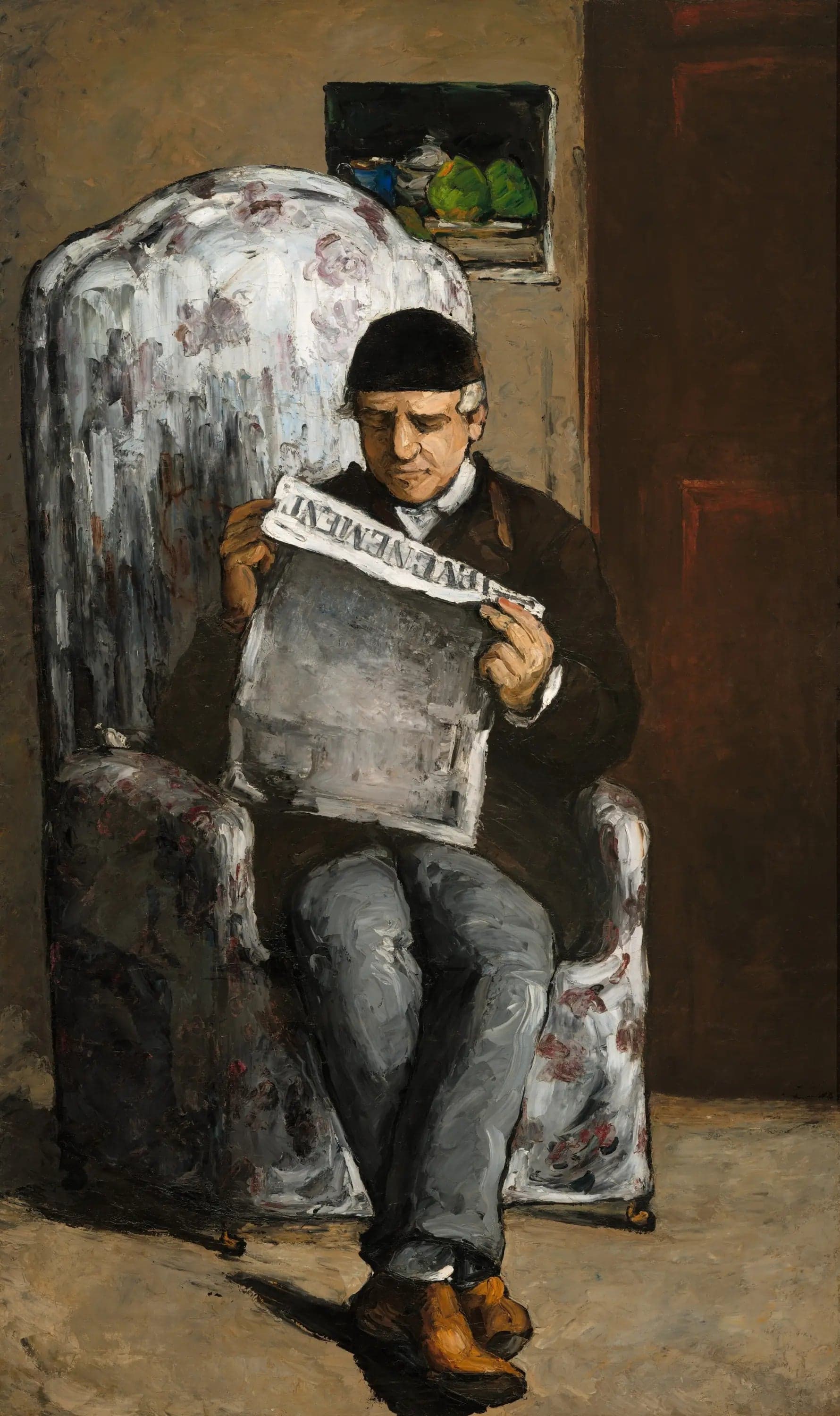
Father of the Artist Reading the Newspaper
- Original dimensions
- 119.3 x 198.5 cm
- Museum
- National Gallery of Art
- Year
- 1866
Scene depicted
In this pictorial work, the artist chooses to represent his father, a middle-aged man, absorbed by a significant event of his time. The intelligent posture of the character, the soft light illuminating his face, and the harmonious details of the environment make this scene both universal and personal. Cézanne succeeds in capturing a moment of tranquility, revealing the love and respect he holds for his father while testifying to a bygone era.
Historical context
Created in 1866, this painting emblematic of Paul Cézanne is part of the Impressionist movement, emerging at the heart of the artistic effervescence of 19th century France. In the vibrant city of Paris, within his light-filled studio, Cézanne captures the intimacy of his father immersed in reading. Currently on display at the National Gallery of Art , this canvas invites viewers to explore the past through its majestic scale.
Place in the artist's career
This painting marks a crucial turning point in Cézanne's career. It is part of a promising first chapter before he evolves into bolder creations like "The Card Players" and "Mont Sainte-Victoire." At this stage, Cézanne begins to develop his own pictorial language, oscillating between perception and reality, a quest that will define him throughout his life as an artist.
Anecdote
"Every brushstroke tells a moment frozen in time." It is with this reflection that Cézanne evokes a sweet spring morning, sitting at his wooden desk, observing his father focused on the news of the world. This moment of introspection gives birth to the deep emotion of the painting , connecting daily life and art.