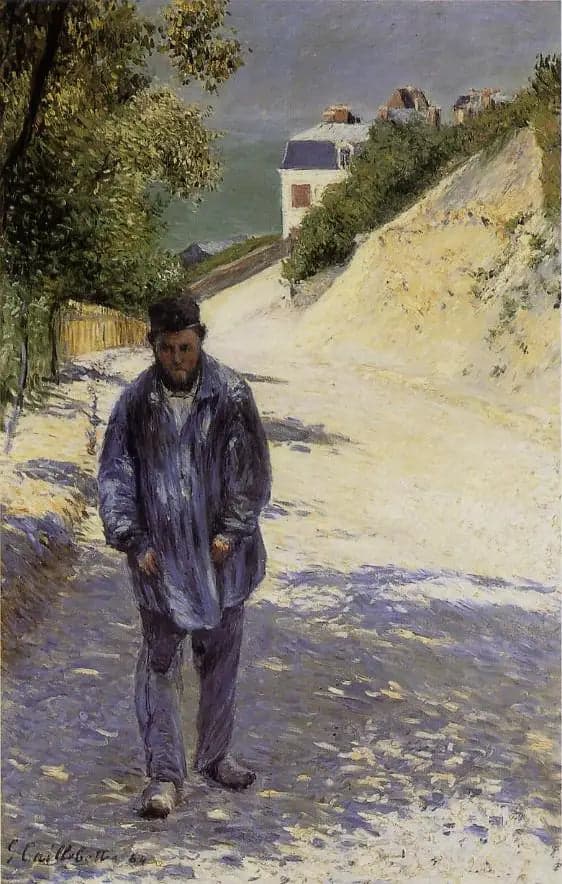
Father Magloire on the way to Saint-Clair in Étretat
- Original dimensions
- 80 x 128 cm
- Museum
- Not specified
- Year
- 1884
Scene depicted
The canvas features a serene walk along the Norman paths, where Father Magloire, true to his name, seems in harmony with the nature surrounding him. The work depicts a soothing landscape, where every detail, from the flowers along the path to the majestic cliffs of Étretat, contributes to creating an atmosphere of relaxation and reflection. The subtle use of light and shadows enhances the tranquility of this scene, thus offering a contemplative view of the beauty of French landscapes.
Historical context
Created in 1884, this painting is emblematic of the Impressionist movement, reflecting the artistic effervescence that prevailed in France at that time. The canvas illustrates the ephemeral beauty of nature while capturing a precise moment on the path of Saint-Clair in Étretat, a coastal town in the Normandy region. Although its current location in a museum is not specified, this work stands out for its impressive dimensions of 80 by 128 cm, inviting the viewer to a poetic contemplation.
Place in the artist's career
The Father Magloire on the Path of Saint-Clair in Étretat marks a turning point in Caillebotte's career as he explores themes of nature and solitude. This masterpiece evokes other significant works such as Paris, Seen from a Balcony and The Floor Scrapers, where the artist merges his love for urbanity with a deep respect for the countryside.
Anecdote
“Nature is a symphony, and each melody must be played in a way that touches the soul,” Caillebotte once remarked. He was inspired by misty mornings, where the rays of the sun caressed the path. This precise moment, where a man, presumably Father Magloire, walked peacefully, is captured with such delicacy in the painting that one can almost hear the whisper of the waves and feel the fresh air of the Atlantic.