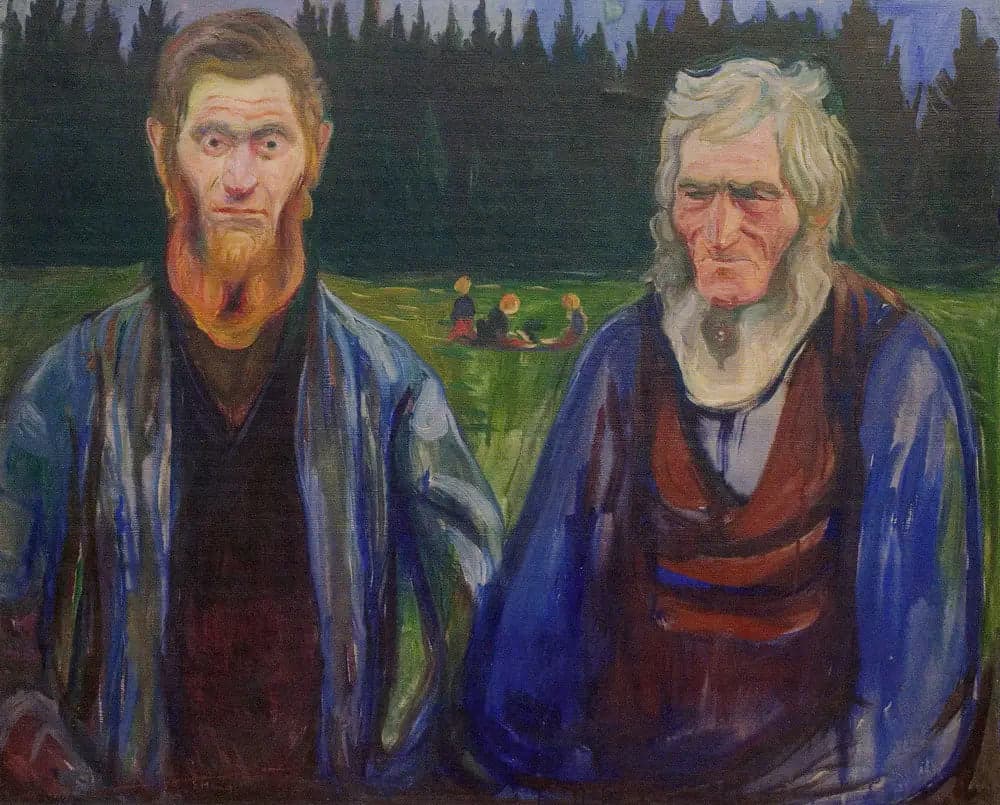
Father and Son
- Original dimensions
- 119 x 96 cm
- Museum
- http://www.wikidata.org/.well-known/genid/d61f9fd271da32b4b35ea9a8c2ba5847
- Year
- 1904
Scene depicted
In "Father and Son," Munch immerses us in a precious moment between a father and his son. The scene depicts a relationship imbued with complicity and affection, surrounded by a serene atmosphere. The exchanged gestures and knowing glances are symbols of a deep connection, transcending time and space. Every detail of this painting tells a story, a memory of a living familial bond.
Historical context
Created in 1904 in the Norwegian capital of Oslo, the painting "Father and Son" belongs to the intense expressionist movement. This painting illustrates a time marked by deep emotions, a period when Munch was able to capture the very essence of human relationships. Currently exhibited in a prestigious museum, this work stands proudly with dimensions of 119 x 96 cm, symbolizing both the intimacy and depth of familial attachment.
Place in the artist's career
"Father and Son" represents a major turning point in Munch's career, embodying a stylistic peak of his work. Alongside his famous "The Scream" and "The Madonna," this canvas highlights the evolution of his style, moving from a more symbolist approach to a bolder exploration of human emotions.
Anecdote
"The pain and joy of a father and his son meet on this canvas, a moment frozen for eternity," Munch might have said when referring to this pictorial work . That day, in the vibrant streets of Oslo, a soft light illuminated the faces, inspiring the artist to create a composition full of sensitivity and tenderness.