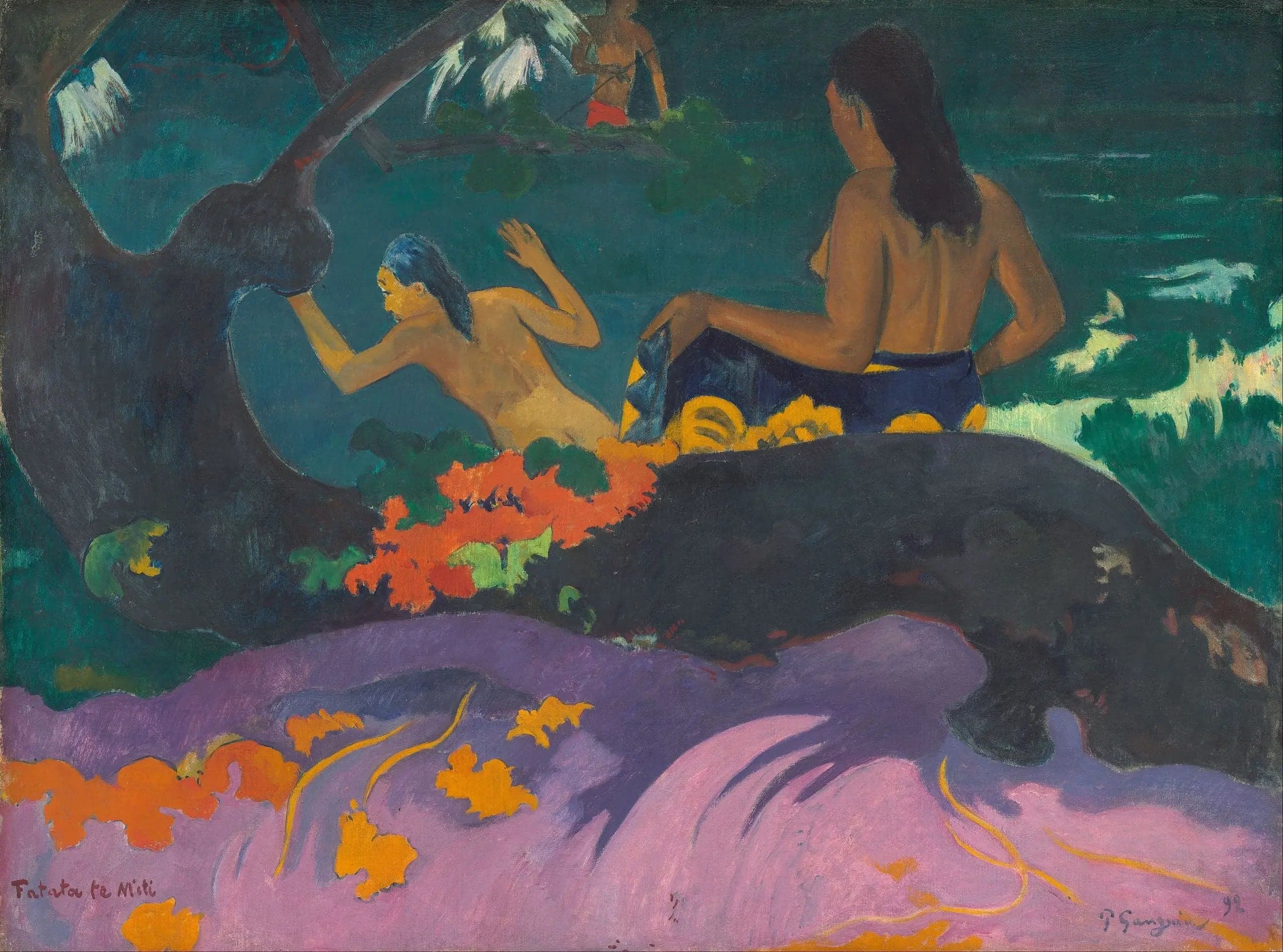
Fatata te Miti
- Original dimensions
- 91.5 x 67.9 cm
- Museum
- National Gallery of Art
- Year
- 1892
Scene depicted
The painting “Fatata te Miti” illustrates a peaceful scene, where Tahitian women bathe in the lagoon, enveloped in golden light. The whisper of the waves and the sweet scent of tiaré flowers permeate the air. Gauguin, through this pictorial work , evokes the natural beauty and mystery of a culture that deeply fascinated him.
Historical context
Created in 1892, in the enchanting landscapes of Tahiti, the painting Fatata te Miti is part of the post-impressionist movement, where Paul Gauguin seeks an original and spiritual expression. This canvas is now displayed at the National Gallery of Art , where its legacy continues to fascinate art lovers around the world.
Place in the artist's career
Fatata te Miti marks a period of maturity for Gauguin, where he abandons conventions to explore pure emotion. Alongside other masterpieces like “Vision after the Sermon” and “The Iréniques,” this canvas testifies to his stylistic evolution towards a bold and colorful visual language.
Anecdote
“I wanted to see the light and colors of life.” These words from Gauguin capture the fleeting moment when he stands on the tranquil shores of Tahiti, observing the dazzling hues of the sea. In Fatata te Miti, the composition becomes a song to island beauty, sealing the emotion of an ephemeral moment.