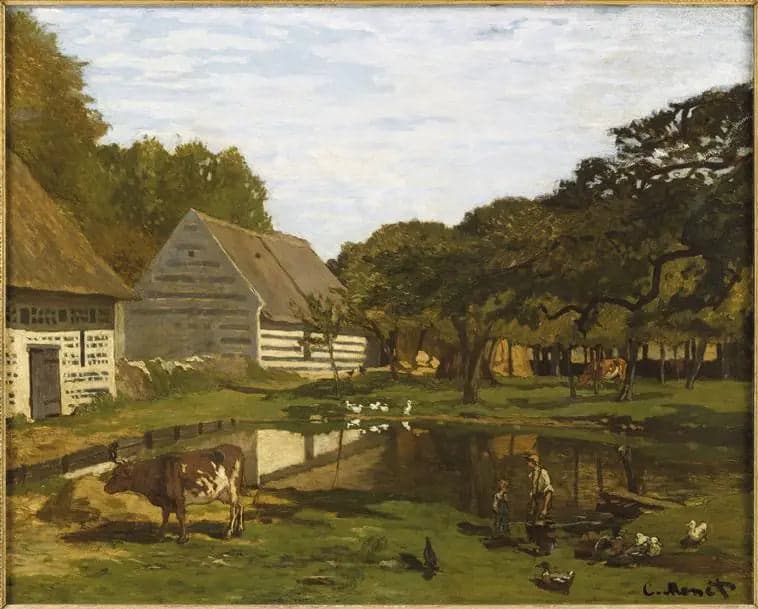
Farmyard in Normandy
- Original dimensions
- 81.5 x 65.2 cm
- Museum
- Orsay Museum
- Year
- 1863
Scene depicted
This painting represents a farmyard, where elements of rural life blend together. The stone buildings, bathed in diffused light, are surrounded by a flourishing garden and lush vegetation, painting a scene of tranquility. The shades of green evoke the serenity of the Norman landscape, while the play of light highlights the lively character of this scene of elegant simplicity.
Historical context
Year: 1863 |BRK| Museum: Orsay Museum |BRK| Dimensions: 81.5 x 65.2 cm
Place in the artist's career
"Farmyard in Normandy" holds a significant place in Claude Monet's career, marking a period of stylistic evolution. In contrast to earlier works such as " Impression, Sunrise " and " Woman with a Parasol ", this painting showcases his mastery of landscape, integrating meticulous details and a bold use of light. During this period, Monet asserts himself as a master of Impressionism , revealing emotions through compositions rich in nuances and softness.
Anecdote
"Nature never ceases to amaze me." It is in this quest to capture the perfect moment that Claude Monet found inspiration for his painting . One April morning, as the first rays of sunlight pierced the mist, he discovered a living tableau: the vibrant tones of light on the stone walls, the sweet scent of freshly cut grass, and the song of birds resonating around him. This fleeting moment, captured with such delicacy in "Farmyard in Normandy," becomes an open window to a peaceful and bucolic world.