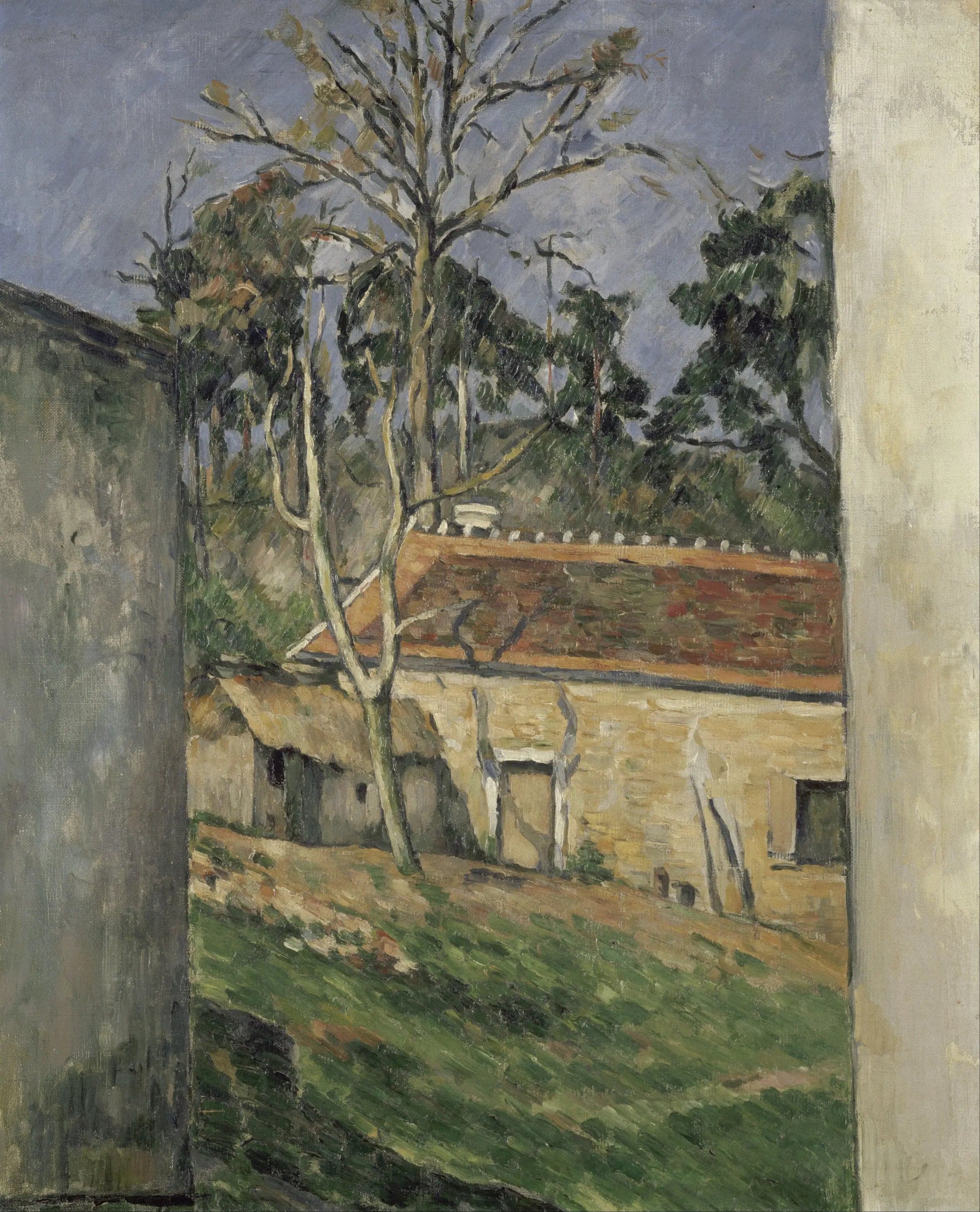
Farmyard in Auvers
- Original dimensions
- 520 x 630 cm
- Museum
- musée d'Orsay
- Year
- 1879
Scene depicted
The painting “Cour de ferme à Auvers” depicts a view of a farm, revealing the harmony between man and nature. Cézanne invites us to contemplate the rustic buildings, surrounded by lush greenery and agricultural tools, connecting us to a time of simplicity and authenticity. This composition evokes serenity in the countryside, transporting the viewer into a peaceful universe where life flows at the rhythm of the seasons.
Historical context
Created in 1879, this painting is emblematic of the post-impressionist movement, which revolutionized the understanding of color and light. Located in Auvers-sur-Oise, a small town in Île-de-France, the painting evokes a time when the rural landscape intertwines with Cézanne's artistic quest. Today, this masterpiece is proudly displayed at the musée d'Orsay in Paris, where its imposing dimensions of 520 x 630 cm captivate every viewer.
Place in the artist's career
“Cour de ferme à Auvers” marks a crucial step in Cézanne's career, illustrating his innovative approach to landscape representation. Throughout his career, he skillfully blended impressionism with a structural rigidity that contrasts with works like “La Montagne Sainte-Victoire” and “Les Grandes Baigneuses.” This painting testifies to the maturation of his style, integrating elements of depth and perspective that define his artistic legacy.
Anecdote
“The beauty of a landscape is not only in what one sees, but in what one feels.” These words resonate at the very heart of the canvas that Cézanne painted one spring morning, as he observed the light caressing the streets of Auvers. It is there, in this enchanting setting, that the artist fell under the charm of a lively scene, blending nature and architecture, which inspired him to capture this image through his painting .