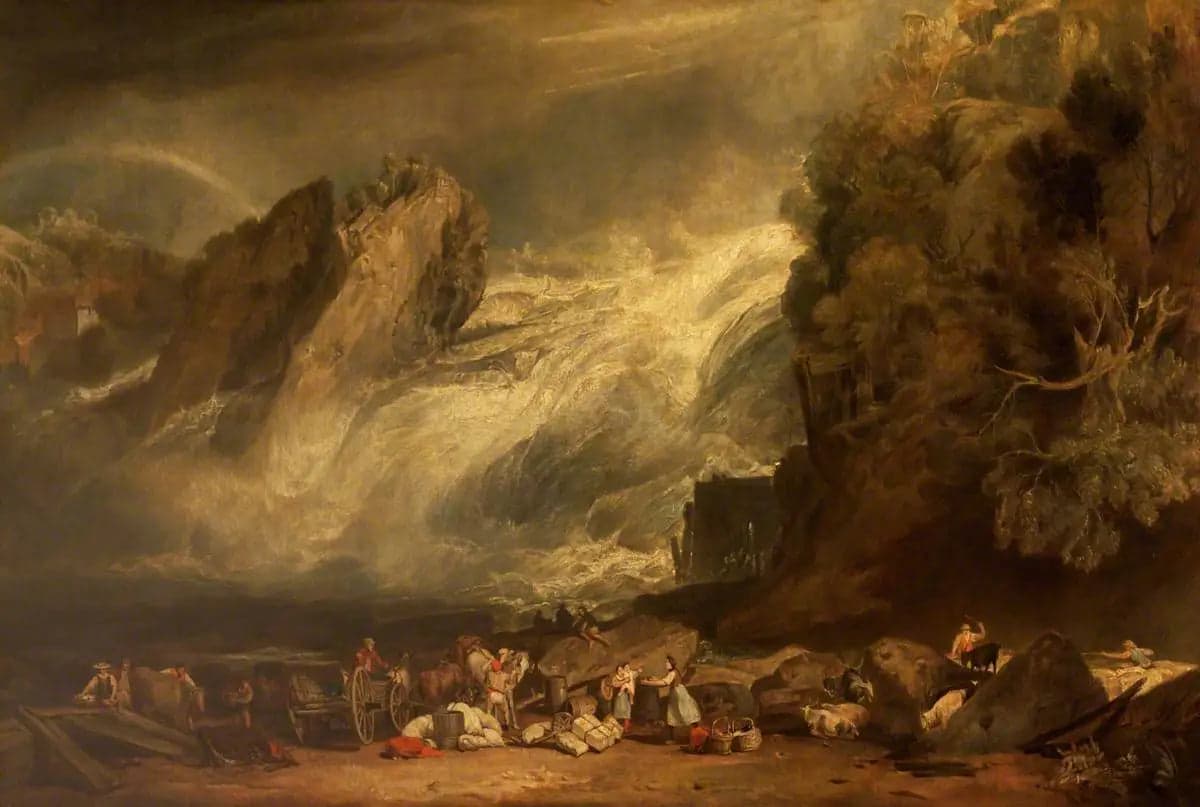
Falls of the Rhine at Schaffhausen
- Original dimensions
- 233.7 x 147.3 cm
- Museum
- Tabley House
Scene depicted
The painting “Falls of the Rhine at Schaffhausen” depicts the majesty of the waterfalls, where the Rhine dramatically widens before plunging with impressive force. Turner manages to capture the omnipotence of nature as the tumultuous waters splash against the rocks, framed by lush green mountains. This painting is an ode to the grandeur of the Swiss landscape, connecting man to the immeasurable force of nature.
Historical context
Created in 1805, during a time marked by romanticism , Falls of the Rhine at Schaffhausen is an iconic painting by the famous British artist Joseph Mallord William Turner . Painted in the picturesque town of Schaffhausen, Switzerland, this canvas illustrates the power and wild beauty of nature, a central theme of the artistic movement of romanticism . Currently, this painting is housed in Tabley House, where it fascinates visitors with its majestic dimensions: 233.7 x 147.3 cm.
Place in the artist's career
Falls of the Rhine at Schaffhausen stands out in Turner’s career as a point of stylistic maturation. It represents not only his growing skill in manipulating light and color but also his deepening exploration of themes of nature. When compared to The Fighting Temeraire and Rain, Steam and Speed , one perceives an impressive evolution: from simple landscapes to works rich in emotions and atmospheres.
Anecdote
“Light is the soul of nature. It is this light that touches us, that awakens us.” These words from Turner resonate through every brushstroke of his masterpiece . Imagine him, one misty morning by the Rhine, passionate about the tumult of the waters, a breath of fresh air filled with the scents of living nature, capturing this moving scene.