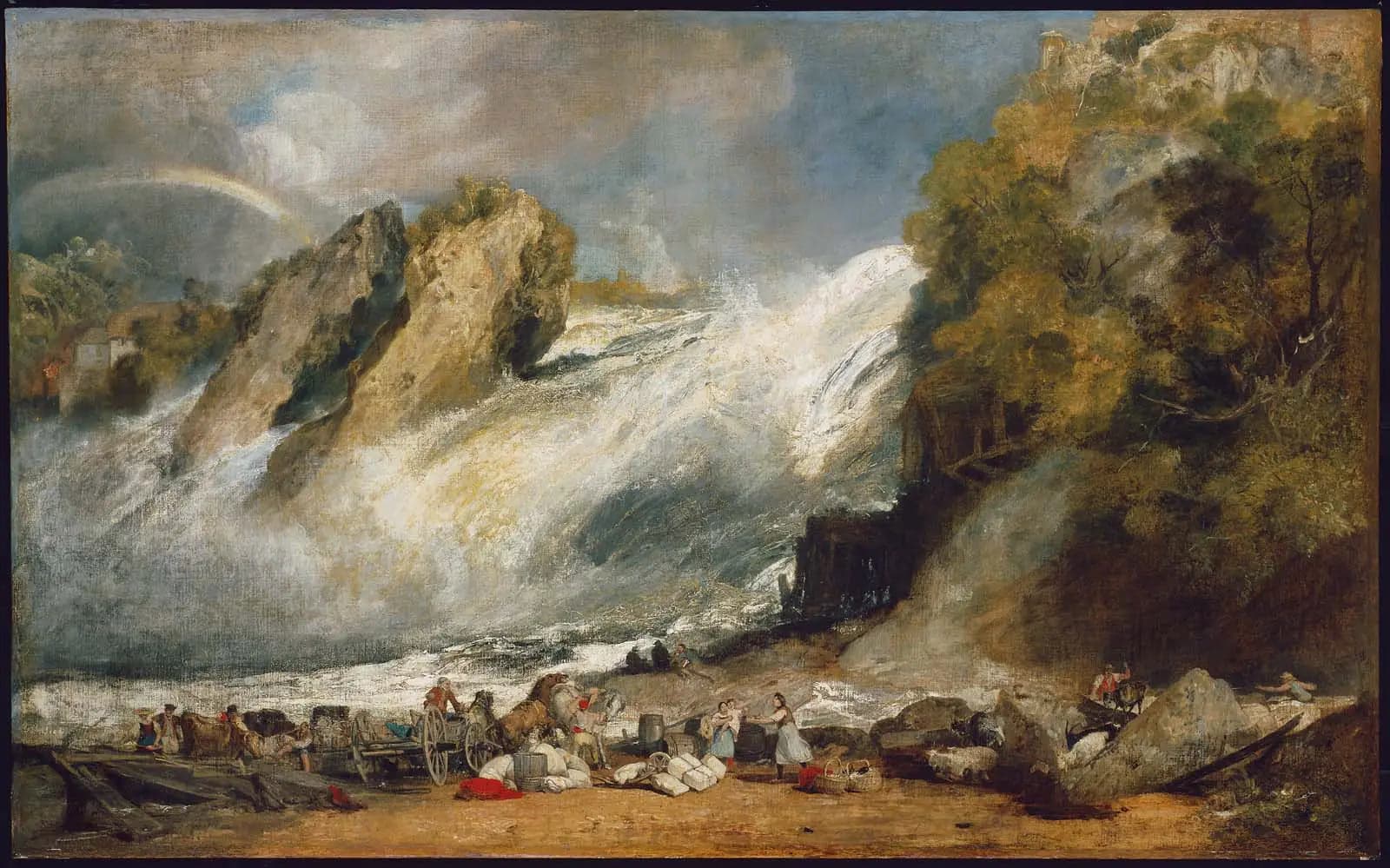
Fall of the Rhine at Schaffhausen
- Original dimensions
- 239.7 x 148.6 cm
- Museum
- Museum of Fine Arts Boston
- Year
- 1805
Scene depicted
The painting “Fall of the Rhine at Schaffhausen” depicts the powerful and splashing waterfalls, surrounded by majestic cliffs and lush vegetation. Capturing the meeting between the sky and the water, Turner uses shades of blue and gray to evoke both the raw power of nature and the serenity of the landscape. This masterpiece is an invitation to feel the grandeur and majesty of the natural world, transcending the mere visual.
Historical context
Created in 1805, this painting embodies the roots of the romantic movement, an artistic movement celebrating the wild nature and deep emotions. Turner captured the majestic fall of the Rhine at Schaffhausen, a picturesque site in Switzerland, where the tumultuous waters blend with a dramatic sky. Currently on display at the Museum of Fine Arts Boston , this canvas , with its imposing dimensions of 239.7 by 148.6 cm, evokes a time when the beauty of landscapes was celebrated like never before.
Place in the artist's career
“Fall of the Rhine at Schaffhausen” is situated at a key moment in Turner’s career, marking his development towards a bolder and more impressionistic style. Alongside his earlier works, such as “The Fighting Temeraire” and “Rain, Steam and Speed,” this canvas demonstrates an increased mastery of light and atmospheres, revealing the evolution of his technique. Through this canvas , the artist embarks on a journey towards a more personal and evocative expression of his emotions in the face of nature.
Anecdote
“I paint to capture what words cannot express.” This quote, although paraphrased, resonates in every brushstroke of Turner. Inspired by a misty morning in Schaffhausen, the artist felt the urgency to transcribe the softness of the wind and the fury of the waters. The painting then becomes an intimate communion between the artist and nature, revealing the brilliance of the moment.