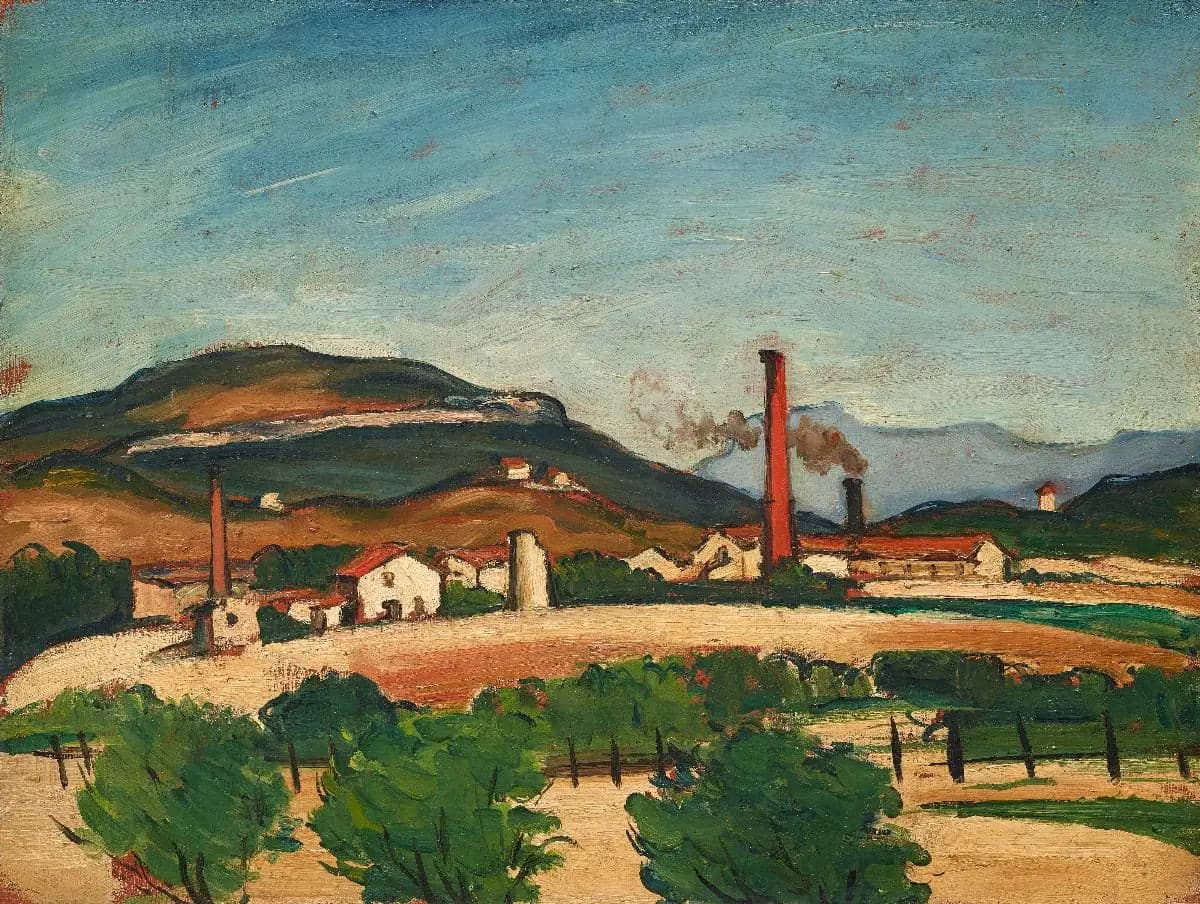
Factories near Mont de Cengle
- Original dimensions
- 55 x 41 cm
- Museum
- Fondation et Collection Emil G. Bührle
- Year
- 1868
Scene depicted
The painting “Usines près du Mont de Cengle” depicts an industrial landscape near the famous mountain, with silhouettes of buildings emerging from the morning mists. Cézanne manages to capture the harmony between nature and man's work, translating the tension between innovation and respect for the environment. A composition that invites reflection on the relationship between the interior and the exterior, the tangible and the imaginary.
Historical context
Painted in 1868, this iconic canvas bears witness to the beginnings of Paul Cézanne 's career, in the industrial landscape then undergoing transformation in Aix-en-Provence, Provence-Alpes-Côte d'Azur. Anchored in the Impressionist movement, the work articulates the influences of nature on the growing urbanization, while revealing the essence of French identity. Today, this painting is located at the Fondation et Collection Emil G. Bührle , an iconic address that highlights masterpieces of European art.
Place in the artist's career
This painting marks a turning point in Cézanne's career, a rise towards greater abstraction and a distinctive style. Through juxtaposition with works such as “La Montagne Sainte-Victoire” and “Nature morte aux pommes”, one can discern the evolution of his pictorial approach. The light, once diffuse, becomes a central actor in the scene, testifying to a growing mastery in the visual language of this exceptional artist.
Anecdote
“Nature is not a backdrop; it is the garden of my mind.” This reflection by Cézanne resonates with the creation of this masterpiece , born from a morning imbued with golden lights, where each factory stands like the notes of a visual symphony, revealing the soul of urban landscapes. The painting evokes this melody of everyday life, the meeting of the smells of iron and earth, a canvas charged with palpable emotion.