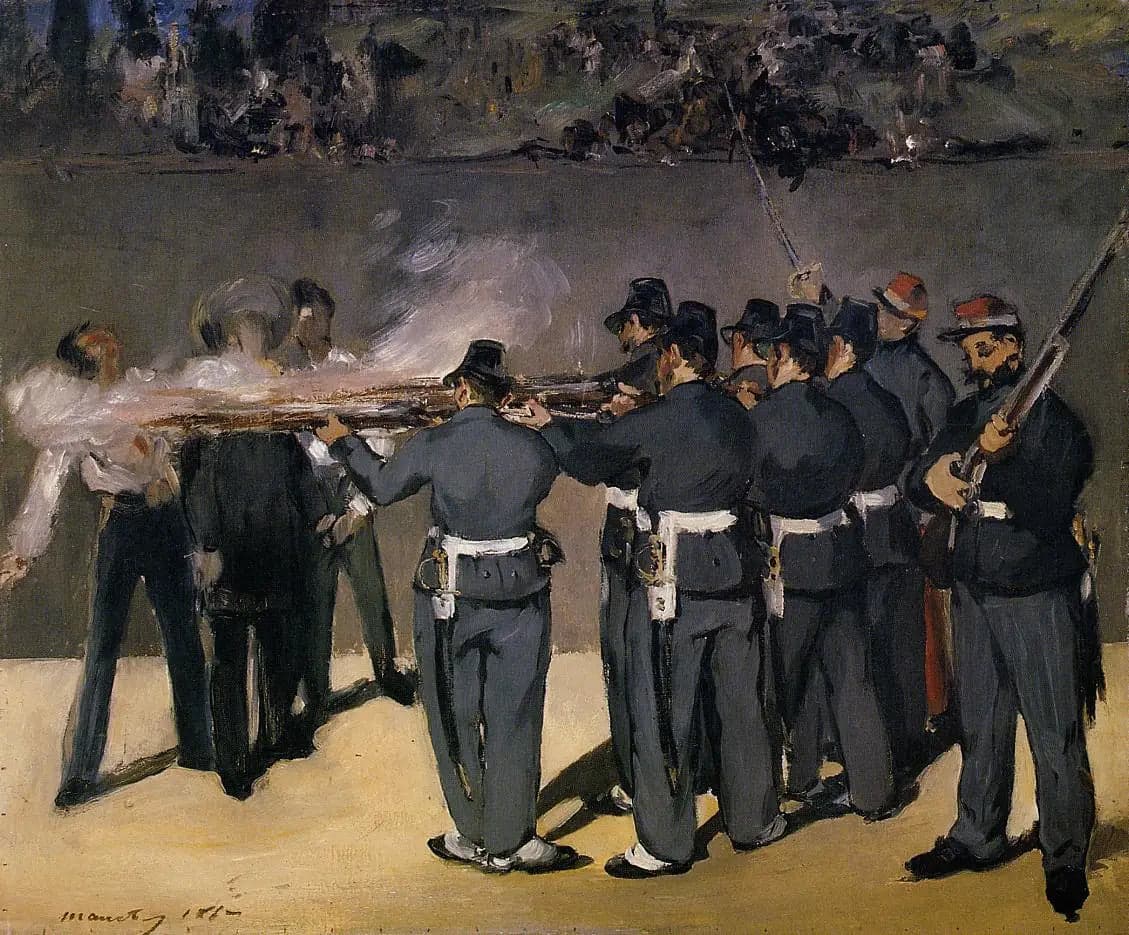
Execution of Emperor Maximilian of Mexico
- Original dimensions
- 284 x 193 cm
- Museum
- National Gallery
- Year
- 1867
Scene depicted
This canvas strikingly illustrates the tragic scene of the execution of a fallen emperor, Maximilian I. The painting poignantly captures the contrast between lost dignity and the horror of violence. Manet, through the power of his pictorial work , freezes a moment that raises questions about power, justice, and the inexorable fate of men.
Historical context
Created in 1867 in Paris, this painting emblematic of the realism movement highlights the historical tragedy surrounding the execution of Emperor Maximilian of Mexico. This canvas , now housed in the National Gallery, reveals not only the craftsmanship of Édouard Manet , but also a crucial moment in 19th-century political history, where France intervened in Mexican affairs.
Place in the artist's career
Execution of the Emperor Maximilian of Mexico stands as a turning point in Manet's career. At this time, he is already recognized as an innovative painter, and this painting resonates with his previous works such as “Le Déjeuner sur l’herbe” and “Olympia,” marking a maturity in his technique. The dramatic strength of this work denotes undeniable mastery while expanding his exploration of political and social themes.
Anecdote
Manet reportedly stated: “Every brushstroke must tell a story.” On this canvas, inspiration may have sprung during a walk along the Parisian quays, where the sound of conversations and the subtle scent of spring flowers fueled his imagination. This fleeting moment, inherent to the birth of the masterpiece , echoes the dramatic power of the painting .