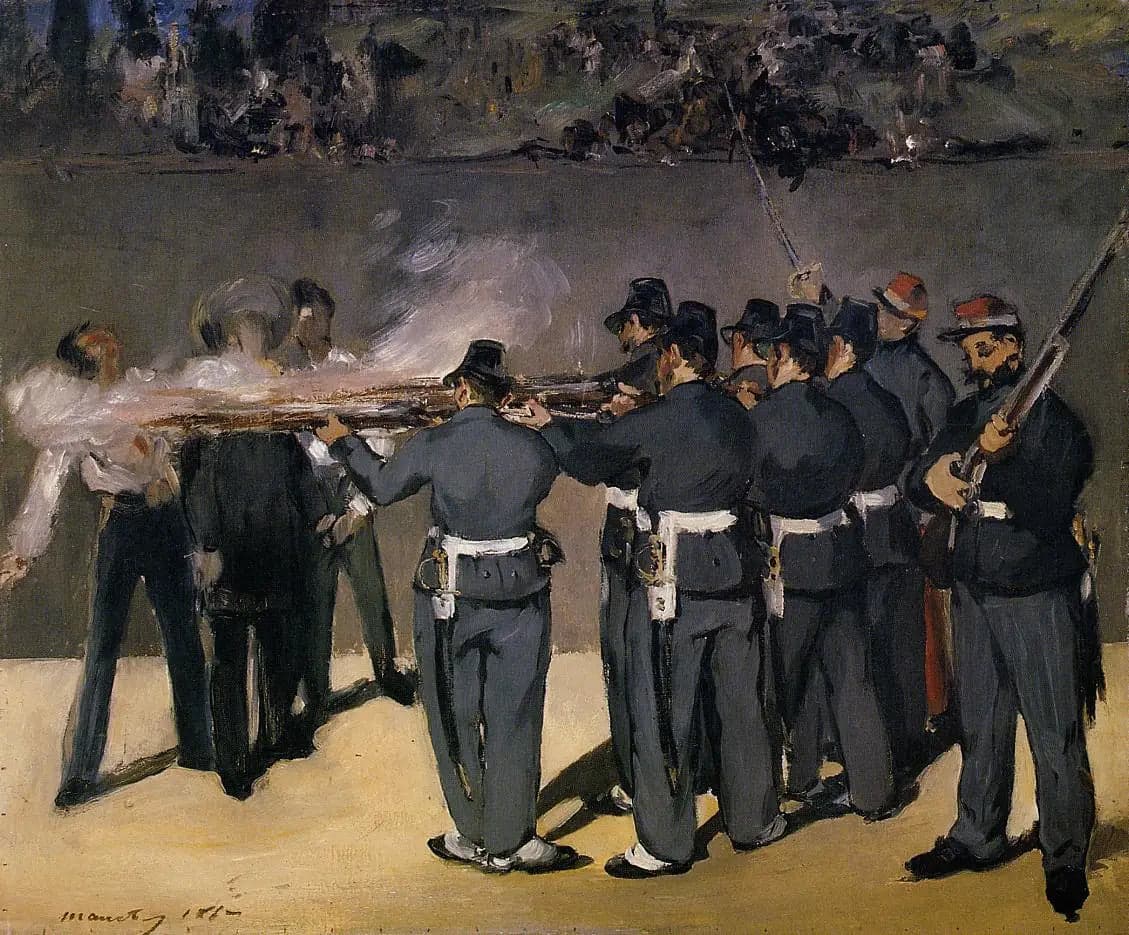
Execution of Emperor Maximilian of Mexico
- Original dimensions
- 259.7 x 195.9 cm
- Museum
- Museum of Fine Arts Boston
- Year
- 1867
Scene depicted
This canvas , powerful and evocative, illustrates the execution of Emperor Maximilian, a scene marked by intense emotion. The characters, frozen in anguish, plunge us into the heart of a human tragedy. Manet skillfully shaped this composition with striking realism , reflecting not only the historical drama but also the universal pain of loss.
Historical context
Created in 1867, the painting by Édouard Manet is set against a troubled historical context, that of the post-Mexican period, as the Empire of Maximilian collapses. This canvas , emblematic of realism , evokes drama and tragedy in a world undergoing profound change. The canvas is currently displayed at the Museum of Fine Arts Boston , carefully preserved for future generations.
Place in the artist's career
This painting represents a turning point in the career of Édouard Manet , a stylistic peak of his maturity. Alongside other works such as “Luncheon on the Grass” and “Olympia,” we perceive an evolution, a technical and emotional mastery that resonates deeply in every brushstroke of the canvas .
Anecdote
Manet said: “Art is an expression of the heart, a cry of the soul.” It is in his studio, bathed in golden light one spring morning, that he imagines the poignant scene of this masterpiece . A suspended moment, a breath of emotion captured on canvas, the unyielding pain of an era merges with the skill of his brush.