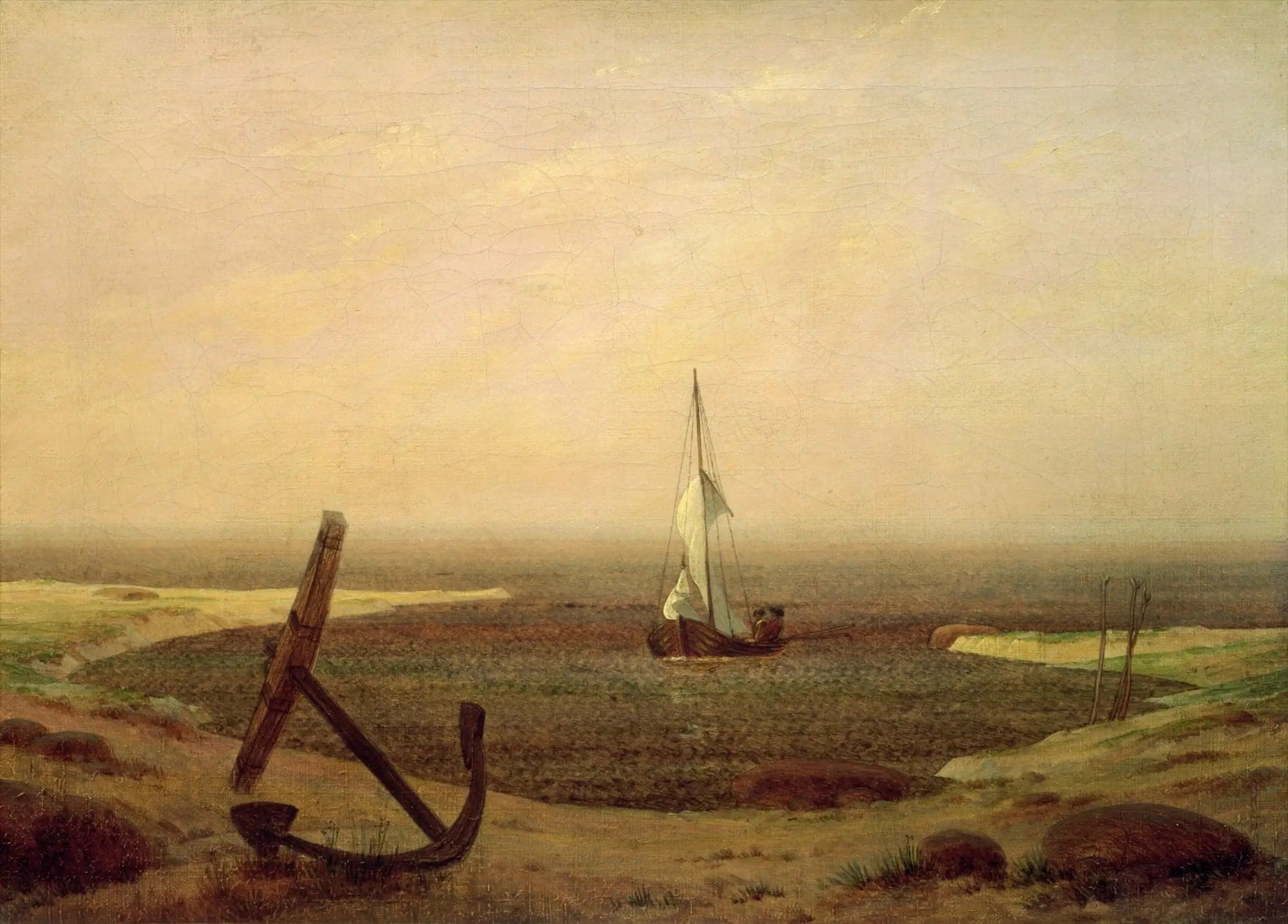
Evening
- Original dimensions
- 25 x 21 cm
- Movement
- romanticism
- Museum
- private collection
- Year
- 1824
Scene depicted
In “Evening,” Friedrich invites us to contemplate the soft shadows stretching across a village landscape. The twilight, majestic and soothing, caresses the silhouettes of the trees, while a distant panorama unfolds, both mystical and serene. This painting evokes the passage of time with such delicacy that each gaze gets lost in its nostalgic atmosphere, creaking with the ephemeral beauty of twilight moments.
Historical context
Created in 1824, the painting “Evening” by Caspar David Friedrich emerges in a fascinating romantic context. This canvas , fragile and poetic, embodies the aspirations of the human soul in the face of the grandeur of nature. Currently, this work is preserved in a private collection, a testament to its excellence and emotional impact. Spanning 25 x 21 cm, this pictorial device transports any observer into a moment suspended between day and night.
Place in the artist's career
This painting , “Evening,” marks an important turning point in Friedrich's career, symbolizing the peak of his artistic expression. Resonating with other iconic works such as “ The Wanderer above the Sea of Fog ” and “The Crossroads,” these paintings reveal a growing emotional maturity. Each of these compositions elevates solitude and the sublime magnificence of the natural world.
Anecdote
As Friedrich aptly said: “Nature reveals the mysteries of our soul.” As he stood before the twilight of a summer evening, the declining light inspired him to create this masterpiece , translating a gentle melancholy, orchestrated by misty horizons and shimmering skies. This moment of introspection became the essence of the painting, infusing each brushstroke with this profound encounter with the sublime.
Major exhibitions
Dahl and Friedrich. Romantic Landscapes