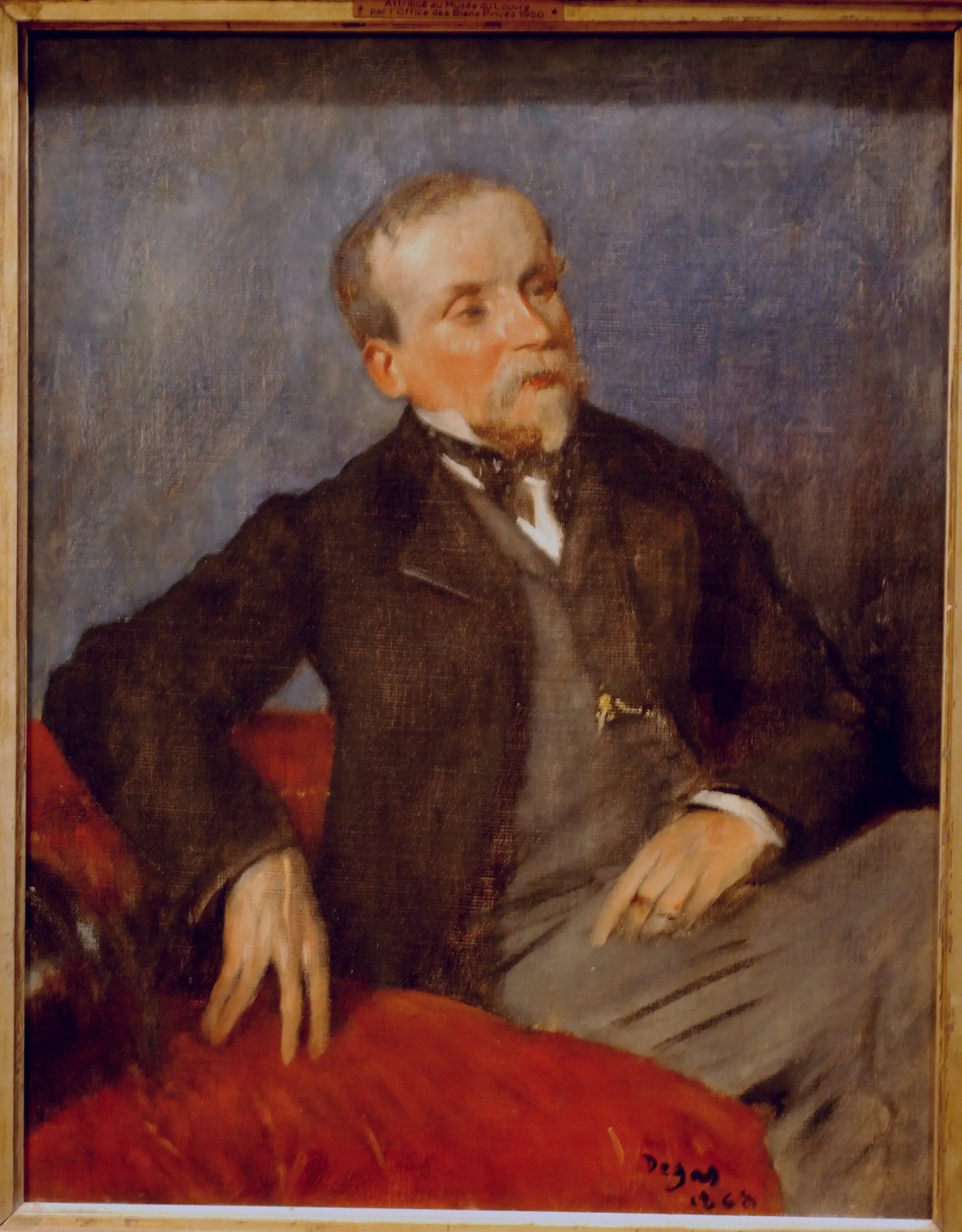
Évariste de Valernes
- Original dimensions
- 46.5 x 59.5 cm
- Museum
- musée d'Orsay
- Year
- 1868
Scene depicted
In this canvas , Degas presents Évariste de Valernes, a young man in all his majesty, elegantly dressed, as a reflection of Parisian high society. The composition reveals a subtle interaction between the human subject and the Parisian environment, evoking a vibrant atmosphere, both joyful and melancholic, linked to the life of the French capital.
Historical context
Created in 1868 in Paris, this painting is emblematic of the Impressionist movement, a pivotal and flourishing period in the history of art. The canvas , now preserved at the musée d'Orsay , finely captures the spirit of the Belle Époque, where light and movement danced on canvas.
Place in the artist's career
Évariste de Valernes marks an intriguing milestone in Degas's career, propelling him towards a new artistic maturity. This masterpiece sits between other canvases such as The Dancers (1874) and L'Absinthe (1876), revealing his stylistic evolution towards a deeper exploration of human emotions and dancing silhouettes.
Anecdote
Edgar Degas once stated: “ Painting is a means of recording fleeting emotions, just as a dance is a celebration that fades into time.” Inspired by a spring morning in the bustling streets of Paris, he found in the silhouette of Évariste an ideal subject to express this ephemeral movement of life through his masterpiece .