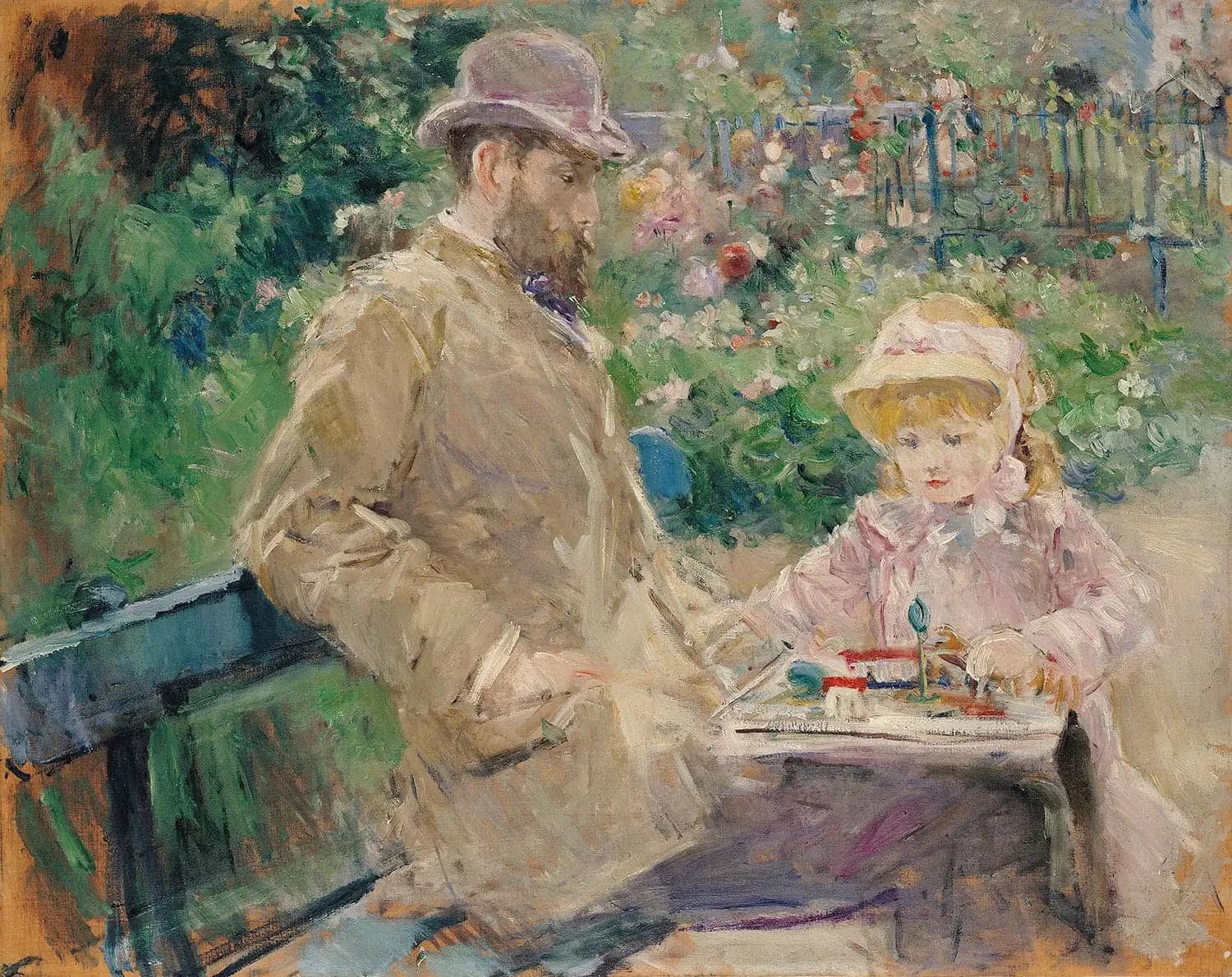
Eugène Manet and his daughter in the garden of Bougival
- Original dimensions
- 92 x 73 cm
- Museum
- Marmottan Monet museum
- Year
- 1881
Scene depicted
This painting evokes the sweet moment shared between Eugène Manet and his daughter, where family life flourishes in the beauty of the garden. Morisot, with her delicate and sensory technique, manages to convey the harmony and palpable affection through the gestures and exchanged glances, rooting this scene in a daily life filled with tenderness.
Historical context
Created in 1881, this painting is emblematic of the artistic dynamic of Bougival, a charming town on the banks of the Seine, known for its peaceful atmosphere that inspired many Impressionist artists. The canvas by Berthe Morisot testifies to the brilliant Impressionist movement, which seeks to capture the light and movement of everyday life. Now exhibited at the Marmottan Monet museum , this painting magnifies the intimacy of the family scene through its dimensions of 92 x 73 cm.
Place in the artist's career
In the career of Berthe Morisot , Eugène Manet and his daughter in the garden of Bougival represents a major milestone, alongside works such as *The Cradle* and *Reading*, reflecting her technical and emotional evolution towards a mastery of light and color, reinforcing her status as a pioneer in the Impressionist movement.
Anecdote
“Life outdoors reveals the most beautiful gaze, that of a child,” could have said Berthe Morisot , referring to the inspiration that drove her to immortalize this unique moment between Eugène Manet and his daughter. The scene is imbued with soft light, a spring morning where the garden awakens to the song of birds and the fragrance of flowers, offering an idyllic setting for this pictorial work .