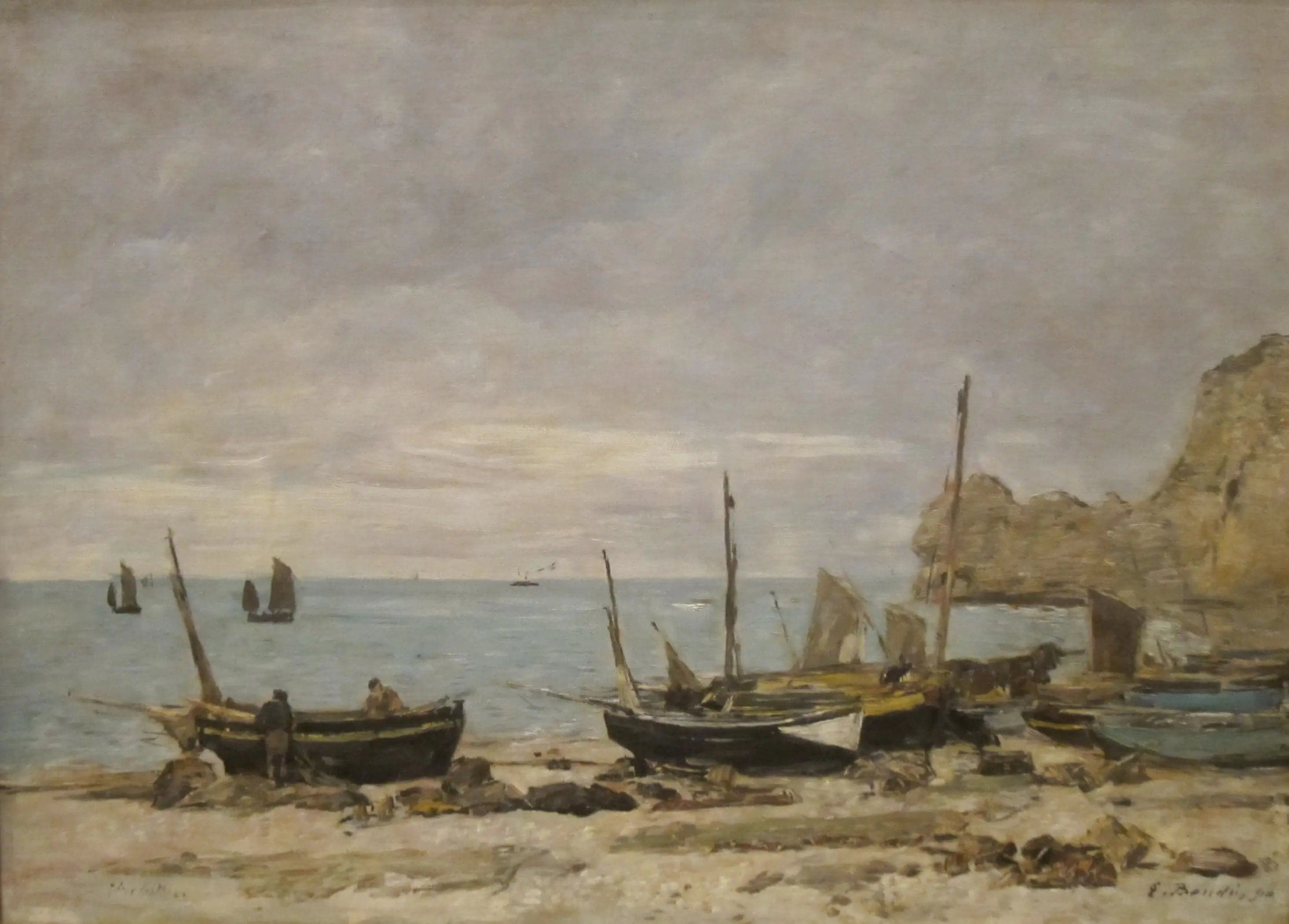
Étretat
- Original dimensions
- 55 x 41 cm
- Museum
- San Diego Museum of Art
- Year
- 1890
Scene depicted
In this iconic painting, Boudin depicts the vertigo of the cliffs of Étretat, like giants rising from the sea. The daylight dances on the waves, while the white sails of the boats rise, imparting a sense of freedom and escape. This work is a celebration of nature and light, an ode to the beauty that surrounds us.
Historical context
Created in 1890, in the charming coastal town of Étretat, this painting is part of the Impressionist movement, highlighting the breathtaking beauty of Normandy. At the top of the cliffs, one can feel the sea air and the peaceful atmosphere of a time when art aimed to be avant-garde. Today, the painting rests at the San Diego Museum of Art , at a scale of 55 x 41 cm, inviting every visitor to dive into a world of colors and light.
Place in the artist's career
"Étretat" represents a significant milestone in Boudin's career, marking his transition from traditional art to luminous experimentation. Alongside his other major works such as "La Plage de Trouville" and "Le Port de Honfleur," this painting demonstrates an evolution towards a freer and Impressionist approach to painting.
Anecdote
Eugène Boudin , known for his love of nature and light, reportedly said: "Every canvas is an invitation to feel the present moment." Imagine the artist, one spring morning, standing on the cliff of Étretat, watching the sea blend with the sky. It is this magic of the moment that the painting captures in its vibrant composition.