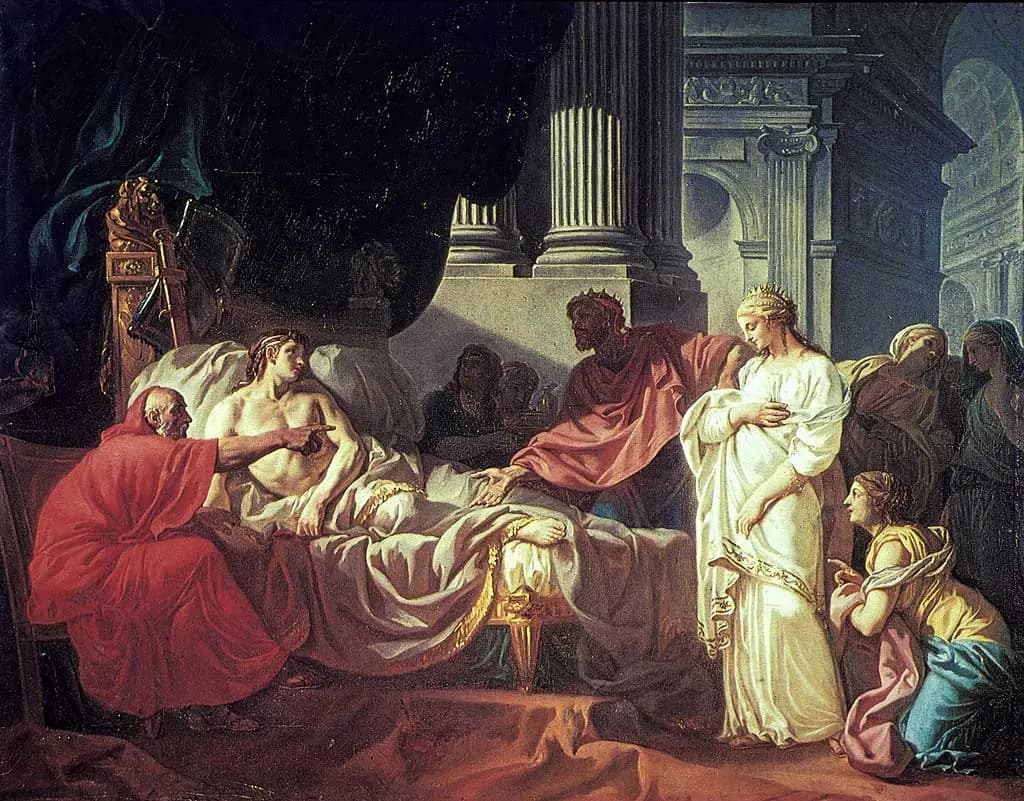
Erasistratus discovering the cause of Antiochus's illness - Jacques
- Original dimensions
- 155 x 120 cm
- Movement
- neoclassicism
- Museum
- École nationale supérieure des beaux-arts
- Year
- 1774
Scene depicted
This narrative canvas depicts Erasistratus, a physician of antiquity, discovering the illness of Antiochus, king of Syria. The palpable tension and intensity of the exchanged glances convey a desperate quest for medical and human truth. Each character is frozen in a suspended moment, where astonishment and pain intertwine, offering a poignant view of the human condition.
Historical context
This painting , created in 1774, emerges in Paris, the City of Light at the end of the 18th century, amidst a vibrant intellectual and artistic effervescence. Jacques-Louis David , an emblematic figure of neoclassicism , captures here a historical scene, imbued with rationality and heroism, which is now carefully preserved within the École nationale supérieure des beaux-arts. This canvas , measuring 155 x 120 cm, embodies the sum of the artistic aspirations of its time.
Place in the artist's career
Erasistratus Discovering the Cause of Antiochus's Illness stands as a significant milestone in David's career, as he transitions from a promising start to an undisputed master of neoclassicism . In reflection, we can compare this canvas to “ The Oath of the Horatii ” and “ The Death of Socrates ,” two works where dramatization and narrative clarity pursue a stylistic and emotional evolution.
Anecdote
“Art must elevate the spirit and enlighten the soul,” said Jacques-Louis David . Imagine him, one spring morning, strolling through the gardens of the Palais Royal, where he draws inspiration for this masterpiece . The daylight illuminating his thoughts, he was able to translate this passion into the painting whose vibrant hues we still admire today.